Peak Performance vs Sustainable Performance: Why More Effort Isn’t Always Better
By
Dr.Liam
/ September 18, 2026
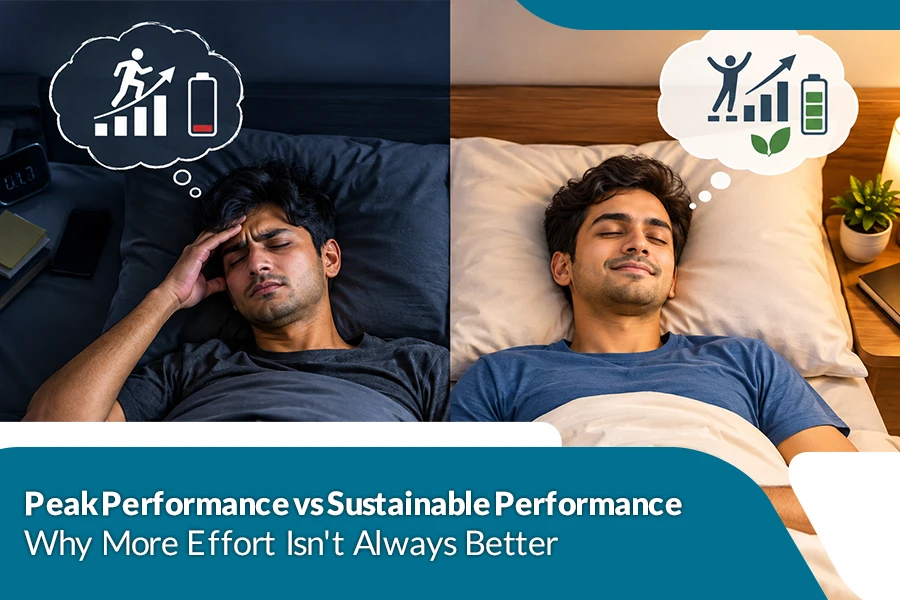
There’s this idea floating around in a lot of workplaces, gyms, and even parenting forums that if something is worth doing, it’s worth doing at full intensity, all the time. Push harder. Do more. Sleep less, care more. And for a while that actually seems to work, which is honestly the annoying part. Peak performance feels good in the short run. It’s the long run where things get messy.
Most research on human output whether it’s athletes, surgeons, or people just trying to survive Q4 at a marketing agency points to the same uncomfortable pattern. Effort and results are not a straight line. They look more like a curve that goes up, flattens and then, if you keep pushing, starts sliding backward. Nobody wants to hear that last part.
Peak performance isn't actually a state, it's a moment
This is where a lot of the confusion starts. People treat peak performance like it’s a lifestyle you can maintain, like eating clean or drinking eight glasses of water. But if you look at how the term is actually used in sports science, peak performance describes a narrow window-the body and mind hitting an optimal point of readiness, usually timed around a specific event. A marathon. A championship game. A product launch, maybe.
It’s not meant to be a Tuesday. It’s meant to be the one day everything lines up.
Somewhere along the way, corporate culture took that word and stretched it across an entire calendar year. Peak performance every quarter. Peak performance every sprint cycle. Which, biologically, doesn’t really hold up. You can’t peak indefinitely, the same way you can’t sprint a marathon. Something in that logic breaks down fast, and usually it’s the person, not the plan.
The gap between short bursts and long careers
Short-term intensity and long-term output actually work against each other more often than people expect. This is one of those things that sounds obvious once you say it out loud but somehow still surprises people every single time.
Studies on high performers, the actual research kind, not the LinkedIn-post kind tend to show that sustained high output depends less on maximum daily effort and more on recovery cycles, consistency, and something researchers sometimes call “load management.” Athletes talk about this constantly. Coaches build entire training calendars around not overtraining. And yet in office settings, the same logic barely exists. There’s no “recovery week” built into most corporate calendars. There’s just… more work.
Employee sustainable performance, the version companies say they want, usually requires the opposite of what peak-performance culture rewards. It requires rest that isn’t earned through exhaustion. It requires slower weeks that aren’t treated as slacking.
Burnout doesn't look like collapse at first
People imagine burnout as some dramatic breaking point. Someone crying at their desk, quitting on the spot, that kind of thing. Sometimes it looks like that. More often it looks like a slow erosion that’s honestly kind of boring to watch from the outside.
Burnout high performers specifically tend to mask it well, which makes it worse. They’re usually the ones still hitting deadlines, still showing up early, still saying yes in meetings right up until they’re not. The performance stays high while the person underneath it is quietly falling apart. That’s the part that gets missed in most performance vs burnout conversations. The metrics don’t dip first. The person does.
There’s a decent amount of research (Christina Maslach’s work on burnout comes to mind, though there’s plenty more since) suggesting that chronic overextension eventually leads to emotional exhaustion, detachment, and a drop in a person’s sense of accomplishment even while external output stays technically fine. Which means by the time the numbers show a problem, the human side of it has already been struggling for a while.
Why does “more effort” quietly stop working?
Effort vs results isn’t a fixed ratio. Early on, yes, more effort usually does mean more output. That’s why the whole grind-harder mentality gets reinforced because in the beginning, it’s not wrong.
But there’s a point, and it’s different for everyone, where the curve bends. Diminishing returns isn’t just an economics term, it applies to attention span, decision quality, creativity, even memory. Past a certain threshold, extra hours don’t add extra value. They just add extra hours. Sometimes they subtract value, because tired decisions tend to be worse decisions, and mistakes made under fatigue take more time to fix than the time saved by skipping rest in the first place.
This is where sustainable high performance starts to look less like a soft, feel-good HR phrase and more like an actual strategy. Not because it’s nicer. Because it’s more efficient, over time, than burning through people (including yourself) at full throttle.
Work life balance isn’t the opposite of ambition
There’s a weird assumption baked into a lot of hustle-culture messaging that balance equals mediocrity. That anyone talking about rest is secretly just less driven. This shows up constantly, and it’s probably one of the more persistent myths in productivity conversations right now.
Work life balance, at least in the way researchers studying occupational health tend to describe it, isn’t about doing less. It’s about distributing effort in a way that doesn’t compound damage over time. Interestingly, in longer performance studies the kind that track people across years, not weeks the individuals who maintained steadier, more balanced routines often outperformed the ones who ran hot early and flamed out. Not always. But often enough that it’s not a fluke.
Peak performance still matters here, to be fair. There are moments where full intensity is exactly what’s needed: a deadline, a launch, a big presentation. That’s not the problem. The problem is treating every day like that day.
Productivity without burnout sounds nice but it’s kind of hard
Saying “aim for productivity without burnout” is easy. Structuring a week around it is not, especially in workplaces where visibility and busyness get confused with value.
Some of the more useful findings from workplace psychology suggest that autonomy, predictability, and recovery time matter more to sustained output than raw hours logged. Not motivational-poster stuff. Actual measurable things like turnover rates, error rates, absenteeism. Companies that build in slower periods, rather than treating rest as a reward for exhaustion, tend to see steadier sustainable work performance across teams. Less dramatic, sure. Fewer viral “grind story” LinkedIn posts. But steadier.
And maybe that’s the uncomfortable trade-off nobody markets well. Peak performance photographs are better. Sustainability doesn’t have a highlight reel.
Which one actually wins?
Depends what you’re optimizing for, honestly, and that’s not a cop-out answer, it’s just true. If the goal is a single high-stakes moment, peak performance is the right tool. If the goal is a career, a team, a company that still exists in five years, sustainable performance tends to hold up better, even if it looks less impressive week to week.
Maybe the healthier framing isn’t “peak performance vs sustainable performance” at all. Maybe it’s knowing when each one is actually needed and not defaulting to maximum effort just because that’s the version everyone claps for. Nobody’s arguing against effort. It’s just that effort without recovery eventually stops being effort and starts being damage control.
FAQs
1. Is peak performance always bad for long-term productivity?
No, it’s fine short-term, for specific moments. The problem starts when it’s treated as a permanent state.
2. What’s the main sign of burnout in high performers?
Output usually stays high for a while even as the person becomes emotionally exhausted underneath it.
3. Can work-life balance actually improve performance?
More often than not, particularly on longer timeframes, steadier routines have a better chance of winning than sporadic high-intensity bursts.
4. Does more effort always lead to better results?
Not past a certain point. Effort vs results follows diminishing returns, not a straight line.
5. How can companies support employee sustainable performance?
There needs to be space for actual recovery time, not just rewarding visible busyness or 24/7 availability.