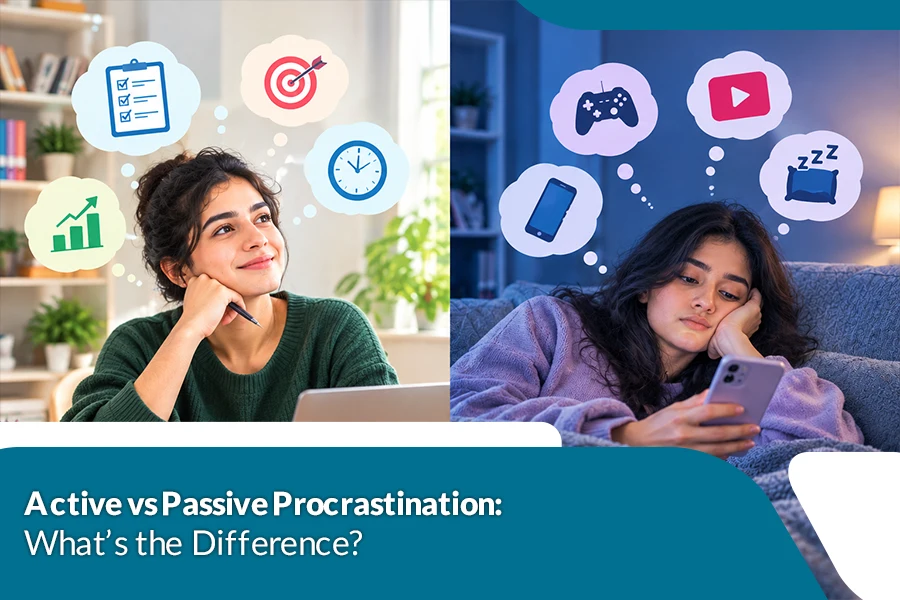
Most people hear the word procrastination and picture someone lying on a couch scrolling their phone while a deadline burns down to nothing. That’s one version of it. But research on the procrastination definition has actually split into two very different camps for a while now, and honestly the split makes more sense the longer you sit with it. There’s active procrastination and passive procrastination, and they don’t feel the same, don’t look the same, and don’t even produce the same results half the time.
So the main point is what exactly is the procrastination definition? Let’s dive in to read about it.
Where did this idea come from?
Psychologists Chu and Choi are usually credited with drawing this line back to the mid-2000s. Before that most of the academic work treated procrastination as one big unified bad habit that needs to be fixed like it is purely dysfunctional. Chu and Choi observed the college students and noticed that there was something wrong with them. Some students who heavily procrastinated were actually doing fine. They had good grades, stress was manageable and everything was well. That didn’t fit the old procrastination definition, which assumed delay always equals harm.
Turns out delay isn’t always harmful. Sometimes it’s strategy. Weird to think about it that way but that’s basically what active procrastination definition is- a deliberate delay, done on purpose, with some kind of internal logic behind it.
Active Procrastination
Active procrastination is the deliberate postponement of decisions or actions. It is the version where someone knows that they are putting something off, chooses to and still pulls off better in the end. It’s intentional procrastination in the sense that there’s a decision involved, not just avoidance creeping in unnoticed.
People who lean into this kind of procrastination definition say things like, “I do my best work under pressure” or “deadlines are the only thing that keep me moving.” Some traits show up again and again in active procrastinators like: They tend to have decent time management strategies even if it doesn’t look like it from outside they can shift into high focus quickly once the pressure hits they usually still finish on time, or close to it they don’t spiral into guilt the same way passive procrastinators do.
That last point matters more than it seems. Guilt is expensive, mentally. If you can delay something and not drown in self-blame while doing it, the whole experience feels lighter, even if the outcome looks identical from the outside. Working under pressure is basically the engine room for this type. Some brains seem to get a small dopamine kick from tight timelines. Adrenaline sharpens attention. Focus narrows. Suddenly the task that felt impossible three days ago gets knocked out in four hours flat. It’s not magic, it’s more like a stress response getting repurposed for output.
Passive procrastination
The passive procrastination definition is closer to what people usually mean when they complain about procrastinating. It usually involves postponing decisions or actions due to an inability to do things in a timely manner. It is the chronic procrastination that people talk about in therapy sessions and productivity articles a thousand times over. The task doesn’t get done because the person keeps finding smaller, easier things to do instead. Cleaning the kitchen suddenly feels urgent. Reorganizing a sock drawer, somehow, becomes today’s priority.
And unlike the active type, passive procrastination usually comes loaded with anxiety. Guilt. Sometimes shame, if it’s been going on for a while. The task looms, the person avoids it more because it looms, and the loop just tightens.
How do you actually tell them apart?
Someone avoiding a task for 3 days on purpose, planning to do it later or they could also be doing it because opening the document could churn their stomach every time they think about it. Same behaviour. Completely different internal experience.
Active procrastinators tend to feel a sense of control even while delaying. Passive ones feel like the delay is happening to them. Active procrastinators usually still hit the deadline. Passive ones often miss it, or scrape in at the very last second in a panic that doesn’t feel good at all. Active types can explain why they’re waiting. Passive types mostly just say “I don’t know, I just couldn’t start.”
None of this is about self regulation skills being present or absent completely because both groups have some level of self-control happening, it’s just aimed differently. Active procrastinators are regulating toward a later payoff. Passive procrastinators are regulating away from discomfort right now, which, ironically, often creates more discomfort later. 


Productivity under pressure myth
An idea that keeps floating around especially in corporations is that everyone works well under pressure and if you just wait long enough you’ll unlock some hidden productive mode. It’s true for the smaller group like the active procrastinators and even for them it’s not guaranteed every single time. Sometimes the pressure works. Sometimes it just produces panic and a worse result than if they’d started earlier. Hard to predict in advance which version shows up.
Even active procrastinators aren’t immune to burnout from doing this constantly. Pulling off last-minute wins repeatedly trains the brain to need that adrenaline spike to function, and eventually the spike stops coming or stops being enough. So “I work better under pressure” can be true for a while and then quietly stop being true, and the person doesn’t always notice the shift until they miss a deadline that used to be easy.
Related: Biohacking for Better Productivity: Science-Backed Habits That Actually Work
Why does the procrastination definition matter for how you fix it?
If someone is an active procrastinator and their system is basically working like deadlines get hit, stress is tolerable, quality holds up; there’s an argument that says leave it alone. Not everything broken needs fixing, and this might not even be broken.
Passive procrastination is a different story. That one usually does need some kind of intervention because the pattern feeds on itself. Time management strategies that work for active types like intentionally scheduling a tight window can actually backfire for passive types, because the anxiety that’s already there gets amplified by an artificial deadline instead of soothed by it.
So generic advice like “just make a schedule” or “break the task into smaller steps” helps some procrastinators and does basically nothing for others, sometimes even makes things worse. Which is probably why so much productivity advice feels hit or miss as it’s built around one procrastination definition, when there are at least two different mechanisms hiding under that one word.
Final Thoughts
Procrastination types aren’t fixed as personality traits are not fixed. A person can be an active procrastinator with work projects and a fully passive one when it comes up to something like an appointment with a physician or emails with a family. Context shifts it. Emotional weight shifts it. So the labels are useful for understanding the pattern in a specific area of life, not as a permanent identity someone gets stuck wearing.
That probably deserves more research honestly, since most of the existing studies group people into one category or the other like it’s fixed.
FAQs
1. What is the basic procrastination definition psychologists use?
Delaying a task despite knowing it could lead to a worse outcome. That’s the short version most studies use.
2. Is active procrastination actually healthy?
For some people, yes, since deadlines still get met without much distress. It’s not universal though.
3. Why does passive procrastination feel worse than active procrastination?
It usually comes with more guilt and less sense of control over the delay itself.
4. Can someone switch between active and passive procrastination?
Yes, often depending on the task, the stress level, or even the day. It’s not a fixed trait.
5. Does working under pressure always improve results?
No. It helps some people some of the time and backfires for others, especially with repeated use.