No products in the cart.
No products in the cart.
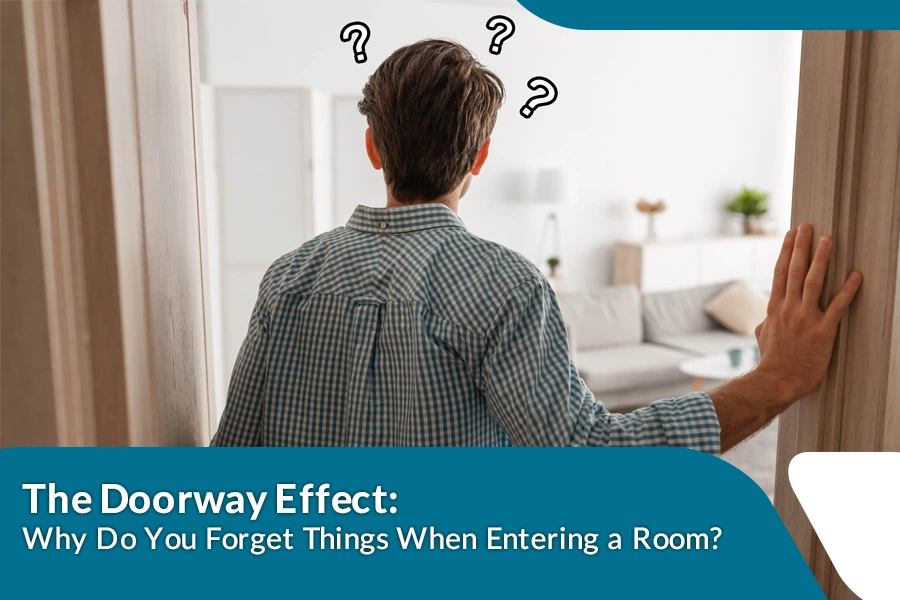
We’ve all had it happen to us. Maybe you want some tissues before you leave the house, you rush to the kitchen, and then suddenly, while standing at the counter, you seem to have completely forgotten what was so important. This is such a common experience that almost all humans have at least once in their lives experienced this phenomenon.
It’s too frustrating sometimes, and several people think that this temporary lapse in memory is indicative of the fact that their memory is worsening, but that’s not the truth and isn’t the full picture. It might feel like your brain just temporarily switched itself off during those moments, but these minor lapses just tell us how our brain organizes information. Researchers have investigated this phenomenon called the doorway effect for quite a while now, and this phenomenon can tell us a lot about our attention, working memory, and how we process the perceptual information around us, i.e., the act of passing through doorways.
Related: Temporal Discounting: The Rememberer’s Dilemma, Memory Systems, and the Value of Waiting
This effect with doorways, which is sometimes also called the location-updating effect, refers to the difficulty that some people might experience in remembering something after they have crossed a physical or mental boundary. You may want to get your keys from your room, but after entering the room, you may suddenly lose all recollection of why you originally wanted to enter the room. What most people do in these situations is that they go back to the original place where they had the thought and try to recollect why they entered the certain room in the first place.
The study that gets quoted most comes from Gabriel Radvansky, a psychology professor at the University of Notre Dame. It was published in the Quarterly Journal of Experimental Psychology back in 2011, and it’s more or less where the doorway effect started getting talked about outside of labs.
The setup was pretty simple, actually. Volunteers, mostly college students, moved through rooms, some in a virtual world on a screen and some in real life. They picked up an object, carried it along, and had to remember what it was. Sometimes they walked across one big room. Other times they walked the same distance but went through a doorway to do it.
Then came the memory test. In both the conditions, the participants walked the same distance, but the ones going through a doorway experienced more forgetting. The door made a difference, not how far one had walked.
The explanation from Radvansky leans on something called an event boundary. The idea is that the mind doesn’t treat life like one long stream. It chops everything into little scenes, kind of like chapters, and a doorway is a really obvious chapter break. One scene ends, another begins.
So the thought, “grab the scissors,” or “what was that password again,” gets filed under the old room. The new room gets a fresh page. The thought isn’t necessarily deleted. It’s more like it got tucked into a drawer that’s now in a different part of the house. Which feels about right, to be fair.
There’s another piece of the research that’s easy to skip. In one experiment, people passed through several doorways and ended up right back in the room where they started. If the problem was only about being in the wrong place, memory should have bounced back. It didn’t really. That hints the doorway itself is doing some of the work, not just the change of scenery.
Although, in everyday life, heading back to the first room does seem to help a lot of people.
Going back to the room helps because the room acts as a cue, a hook for the memory that we seem to have forgotten.
That mental notepad is basically a sticky note. It holds a few things for a few seconds, and “go get the charger” sits on it just fine. Then the mind crosses a threshold and updates the big question of where it is and what’s happening now. The sticky note slides to the back. Whatever belongs to the current scene is easier to grab, and whatever belonged to the last one gets harder. That’s the gist, anyway.
And it’s not even dramatic. No alarm goes off at the threshold, no flash of confusion. The person just steps through, and a few seconds later the errand is missing, like a word on the tip of the tongue that won’t come.
For a long time the usual answer was just a failure of attention. Attention span gets blamed for everything lately, like phones, social media, and whatever is trending. And attention surely plays a part. But the doorway effect points at something more specific than someone not paying attention. The person was paying attention. The scene just changed on them.
Real life isn’t a clean lab. A person walking into the bedroom is usually also carrying a phone, half a conversation, a to-do list, and a vague worry about Thursday. All of that competes for room.
Poor sleep makes it worse. Stress makes it worse. A rough patch of brain fog can make these little slips feel way bigger than they are, like something is badly off when it’s really just a tired mind and a doorway.
So the doorway effect is probably the trigger, and the rest is more like fuel. That’s one way to look at it, anyway.
Related: How Stress Impacts Sleep Quality and Cognitive Function
Most of the time, this is ordinary. Pretty much everyone does it, young people included (the original studies used students, remember). On its own it’s not a sign of anything. Worth repeating, because the worry spiral is real.
Still, there’s a difference between losing a thought at the door and, say, getting lost on a street that used to be familiar, asking the same question over and over, or struggling with everyday tasks that used to be easy. Ongoing memory loss like that, or anything that keeps getting worse, is something a primary care provider should hear about.
Cognitive health is a much bigger thing than one forgotten errand. Sleep, mood, and other health issues can all play in, and a professional can sort out what’s normal and what isn’t. No need to guess alone.
Going back to the room where the thought started is the classic one. It sounds silly, and it still works a lot of the time, since the surroundings pull the thought back out. As mentioned, the spatial surroundings of the room act as a sort of hook that can help pull the thought out from where it seems to be forgotten.
Another is saying the task out loud before moving. “Scissors. Drawer.” Hearing it seems to make it stick a bit better. Or pausing right at the door for one second, a tiny reset, just long enough to repeat the goal once. Some people text themselves a note. Some leave the item by the door so it’s there on the way back.
Sleep, food, and movement matter too, since general brain function runs on them. None of it is some big memory improvement program. Just small habits that give a thought a better chance of surviving the doorway phenomenon.
It’s one of those psychology facts that sounds made up until it happens twice before lunch. Then it’s just accurate. The doorway effect has been catching people out in hallways for as long as there have been hallways, and nobody has to feel silly about it.
Forgetting things at a doorway feels personal, but it’s mostly the mind doing its filing job a little too eagerly. The thought usually isn’t gone for good either. Sometimes it shows up five minutes later, in the middle of brushing teeth, with no explanation. That part is its own mystery.
Related: How to Improve Memory and Recall in Everyday Life
1. What is the doorway effect?
A brief mental reset that happens when someone passes through a door, making thoughts from the previous room harder to reach.
2. Is the doorway effect a sign of dementia?
Not on its own, since it shows up in healthy people all the time. Frequent or worsening memory problems are worth raising with a doctor.
3. Does getting older make it worse?
Memory slips can become more common with age, but the original research used college students, so it’s not just an older-adult thing.
4. Can the doorway effect be avoided?
Not completely. Repeating the task out loud or going back to the first room often helps.
5. Why does going back to the first room help?
The surroundings act as a cue, a hook of sorts, and can bring the original thought back.

Modamindfuels is a source for detailed information on mental health and its medications, focusing on the treatment of sleep apnea, narcolepsy, and bipolar disorder. The content on this website is intended for general informational purposes only and does not constitute professional medical advice, diagnosis, or treatment. These medications may have side effects, interactions, and contraindications. We do not accept any liability for damages or injuries arising from the use of information or drugs provided on this website.