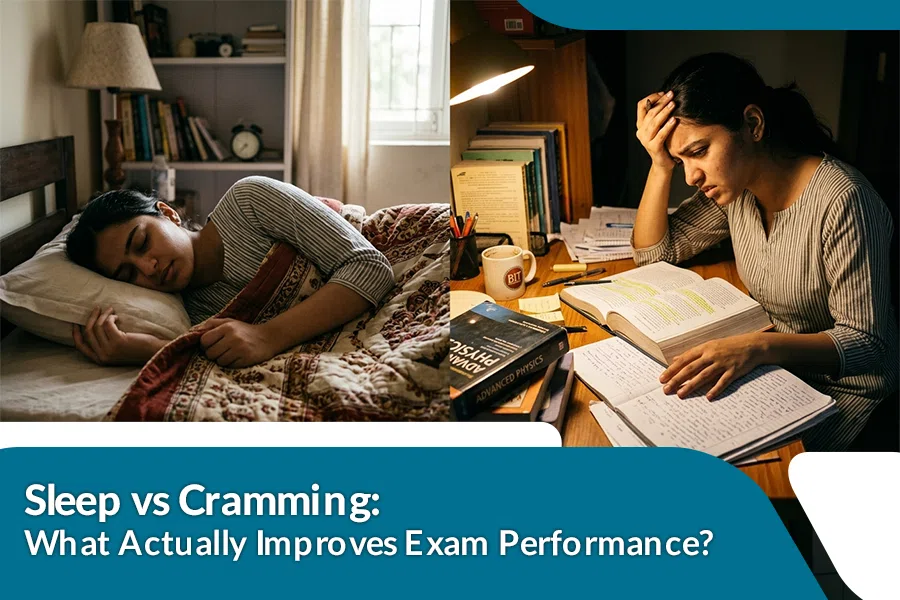
Even setting aside memory consolidation – just the basic cognitive performance side of this is worth taking seriously.Sleep deprivation wrecks your ability to think clearly. Not in an obvious way where you feel stupid. In a subtle way where you feel fine but your processing speed, your working memory, your ability to catch your own mistakes – all of it is degraded. Students who cram and skip sleep often don’t realise their performance is worse because they feel alert enough. Especially if they’ve had caffeine.
Some students have tried medications like Modafinil – a wakefulness promoting drug – to stay sharp during exam season. And it does keep you awake. That part works. But Modafinil doesn’t actually replace what sleep does for memory storage. You can be awake and functional and still have your consolidation disrupted if you’re skipping sleep to use it. It’s a nuance that gets lost when people talk about it as some kind of exam hack.
Why Does Cramming Feel Like It Works?
This is genuinely the most confusing part and I think it’s the reason people keep doing it. Cramming does work. Temporarily. If you load up on information the night before, you will remember more of it the next morning than if you’d done nothing. That’s real. Short-term recall is real. Your brain holds things in a kind of buffer.
The problem is that the buffer clears pretty quickly. Within a day or two, sometimes hours, a lot of it is gone. So if your exam is tomorrow morning and you crammed last night, you might actually do okay. But if you’re tested on the same material a week later, or if the course builds on itself, you’re in trouble. And here’s the contradiction: people who cram and do okay on the exam conclude cramming works. Which is sort of accurate in the narrowest possible sense, and completely wrong in every other sense.
Better exam scores, the kind that come from actually understanding material, come from spacing. Reviewing things across multiple sessions with sleep in between. That’s not exciting advice, I know. But the research on it is honestly pretty overwhelming.
What Study Techniques Actually Hold Up
Spaced repetition is probably the single most evidence-backed approach to learning retention. The idea is you review material at increasing intervals – shortly after learning it, then a few days later, then a week, then longer – and each time you review it just before you’re about to forget it. Sleep during exam season, used correctly, is part of this cycle. You study, you sleep, the brain files it, you review again later. Active recall – testing yourself instead of re-reading – works better than passive review by a significant margin. It’s uncomfortable because you feel like you’re failing when you can’t remember things. But that struggle is actually the learning happening.
Interleaving topics rather than blocking them (doing a bit of subject A, then B, then back to A) is also weirdly effective, even though it feels less organised. None of these techniques require you to study more hours. They require you to study differently and sleep properly. Student productivity, in the actual research sense, isn’t about hours at a desk – it’s about what happens to information after you leave the desk.
The Part Where I Get a Bit Ranty
Here’s what bothers me about the “sleep or study” framing. It sets them up as opposites, like you’re choosing between preparation and rest. But that’s wrong. Sleep is preparation. It is part of the academic performance equation, not separate from it. Learning and sleep aren’t two different activities. Learning is incomplete without sleep. You’re doing half a process.
And yet the culture around exams – especially in competitive universities – actively rewards the appearance of suffering. Staying up late is worn like a badge. “I only got three hours last night” said with a kind of exhausted pride. Which is fine as a coping mechanism I guess, but it’s terrible as a strategy.
Some students turn to things like Modafinil to close the gap – to study longer and still feel functional. And look, there are legitimate clinical uses for it. But in the context of exam prep tips, it’s a bit like putting more fuel in a car with a broken engine. You might go further but the underlying problem – poor sleep hygiene and disorganised study habits – doesn’t get fixed.
What Does Sleep During Exams Actually Look Like in Practice?
Sleep during exams doesn’t mean sleeping ten hours every night and doing nothing else. It means treating sleep as a non-negotiable part of your revision schedule. Like, you plan around it the same way you plan around lectures. Some people find that reviewing material in the hour or two before sleep helps – there’s a bit of evidence that information encoded just before sleep might get slightly preferential treatment during consolidation. This doesn’t mean cramming at midnight. It means a calm review of things you’ve already studied, not first exposure to new material.
Naps also do something, by the way. A 20-minute nap after a study session has shown some benefit for retention. Not a replacement for night sleep, but not nothing. The main thing is just consistency. Going to bed at the same time, waking at the same time, not destroying your rhythm in the final week before exams because that’s the worst possible time to mess with sleep quality.
Final Thoughts
Students who get adequate sleep in the nights before exams perform better than those who don’t, controlling for how much they actually studied. And students who use spaced study with proper sleep across the weeks leading up to an exam outperform students who cram at the end, even when total study hours are similar.
The gap isn’t massive for every student in every subject. But it’s consistent. And over a degree, consistent improvements add up. Exam preparation tips that don’t include sleep are, genuinely, incomplete. That’s not really a controversial statement in the research. It’s just not talked about enough in actual student culture.
FAQs
1. Is it better to sleep or study the night before an exam?
If you’ve been revising consistently, one more night of cramming won’t add much – but losing sleep will cost you.
2. How many hours of sleep should a student get during exams?
7-9 hours is the generally recommended sleep range for adults. Less than 6 hours of sleep consistently hurts cognitive performance noticeably.
3. Does sleep actually help with memory for studying?
Yes – memory consolidation happens during sleep, so skipping it literally disrupts the process that saves what you studied.
4. Is cramming ever useful at all?
Yes. If your exam is tomorrow morning and you haven’t looked at something, a quick review helps. Just don’t expect it to stick.
5. What if I genuinely can’t sleep before an exam because of anxiety?
Even lying down in a dark room without a screen helps somewhat. If it’s a consistent problem, speaking to your physician is worth it – sleep anxiety around exams is genuinely common and treatable.