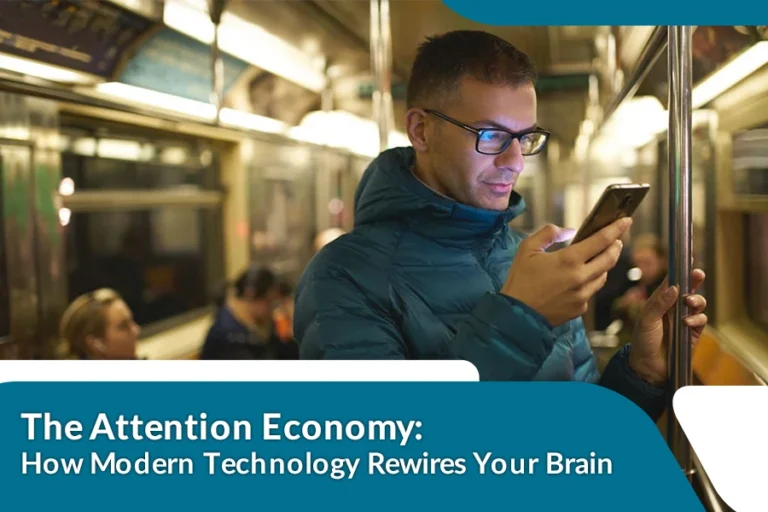
There’s this thing that happens when you pick up your phone to check the time and then – somehow-twenty minutes have passed and you’re watching a video of someone making a clay pot in rural Japan. You didn’t decide to do that. You just… ended up there. And I think about that a lot, honestly. More than I probably should.
We don’t talk enough about what’s actually happening when that occurs. Not in a real way. People say “oh, social media is addictive” like it’s some casual observation, but that’s underselling it. The attention economy and brain relationship is genuinely one of the more unsettling things happening right now, and most of us are just… living in the middle of it, barely noticing.
What is the Attention Economy?
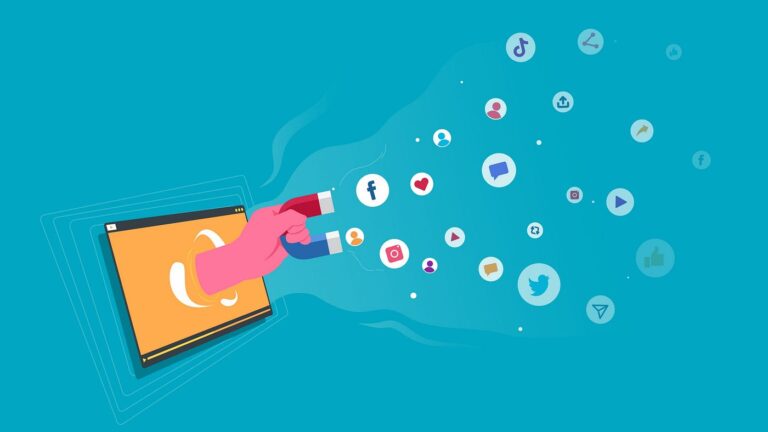
Okay, so the basic idea is this: companies make money when you look at things. Ads, content, whatever-every second your eyes are on a screen is, technically, a unit of value for someone else. Your attention is the product. You’ve probably heard that before. But hearing it and actually sitting are two different things.
The term itself has been around since the late 90s, economists and media theorists kicking it around. But it didn’t really start mattering to regular people until smartphones became the thing you carry everywhere and check constantly. Now the attention economy isn’t some abstract concept-it’s why your phone has seventeen apps that all want you to open them right now.
What’s wild is how much engineering goes into this. Not just algorithms, but actual behavioral science. The variable reward loop-where you don’t know if the next scroll will bring something good or boring-that’s borrowed directly from slot machine design.
Your Brain Wasn't Built for This
The attention economy and brain problem isn’t that technology is bad or whatever – it’s more that our brains are running on hardware that evolved for an entirely different context. Hunter-gatherer stuff. Watching for movement in tall grass, tracking social hierarchies in small groups. Not infinite content feeds.
So when you’re on social media and I mean really on it, not just glancing at it – you’re basically handing your nervous system something it has no evolutionary precedent for. The novelty signals keep firing. Dopamine keeps doing its thing. And your prefrontal cortex, which is responsible for sustained focus and long-term thinking, starts taking a backseat because the limbic system is just… overwhelmed and thrilled at the same time.
Brain and technology researchers have started documenting what this does over time. There’s evidence that the default mode network-the part of your brain that does background processing, daydreaming, consolidating memories gets disrupted when you’re constantly context-switching between digital inputs. Which sounds very academic and kind of abstract until you realize it probably explains why you can’t finish a book anymore. Or why you zone out in the middle of a conversation and feel vaguely guilty about it.
Digital distractions aren’t just annoying interruptions. They’re restructuring how your brain allocates resources.
The Attention Span Decline Thing Is Real But Also Complicated
You’ve probably heard the statistics-that humans now have a shorter attention span than a goldfish. That’s not quite accurate, actually, and it got misrepresented pretty badly in the media cycle. But attention span decline is real in a different, messier sense. It’s less about raw attention capacity and more about willingness to stay uncomfortable. When everything is designed to instantly reward engagement-shorter, faster, more stimulating – your tolerance for anything that isn’t that starts to erode. And I don’t mean that as a moral judgment, it’s just kind of how conditioning works.
I’ve noticed it myself. Reading long articles takes more effort than it used to. Not because I’m less intelligent or whatever, but because some part of my brain has learned to expect a new input every few seconds. When that doesn’t come, there’s this faint restlessness. A pull toward the phone. It’s subtle and it’s constant and it’s kind of exhausting when you actually pay attention to it.
The attention economy and brain connection here is almost circular-the more fragmented your attention becomes, the more the platforms benefit, because fragmented attention is more easily redirected. It’s not a conspiracy exactly, it’s just an incentive structure that happens to be terrible for your cognitive health.
Best Sellers
-
Modavinil 200mg (Modafinil)
$69.00 – $449.00Price range: $69.00 through $449.00Shop Now This product has multiple variants. The options may be chosen on the product page -
Modafil Md 200 mg (Modafinil)
$70.00 – $749.00Price range: $70.00 through $749.00Shop Now This product has multiple variants. The options may be chosen on the product page -
Modvigil 200mg (Modafinil)
$69.00 – $449.00Price range: $69.00 through $449.00Shop Now This product has multiple variants. The options may be chosen on the product page -
Vilafinil 200 mg (Modafinil)
$69.00 – $449.00Price range: $69.00 through $449.00Shop Now This product has multiple variants. The options may be chosen on the product page -
Modafresh 200 mg (Modafinil)
$69.00 – $449.00Price range: $69.00 through $449.00Shop Now This product has multiple variants. The options may be chosen on the product page -
Modvigil MD 200 mg (Modafinil)
$69.00 – $395.00Price range: $69.00 through $395.00Shop Now This product has multiple variants. The options may be chosen on the product page
Cognitive Overload Is Probably What You're Feeling
Cognitive overload is a real psychological concept, the idea that working memory has a limit, and when you exceed it, performance degrades. Decision fatigue is part of this. So is the constant low-level monitoring most of us do with our phones. Even when you’re not actively looking at your device, knowing it’s there and might need attention uses up mental bandwidth.
Concentration issues for a lot of people right now aren’t about ADD or anxiety or whatever else gets blamed – sometimes it’s just that the environment has become genuinely hostile to sustained focus. That’s not the person’s fault. That’s an environmental design problem.
Social Media Attention and Why It Hits Different
There’s something specific about social media attention that makes it more consuming than, say, watching TV. Social media is interactive and unpredictable in a way that television isn’t. Other people are on the other end. There’s social stakes – likes, comments, the possibility of conflict or validation. Your brain treats that as genuinely important information, because historically, social information was important. Getting it wrong had consequences.
So you can’t quite watch Instagram the way you watch a movie. Part of your brain is always processing it as a social situation. That keeps you more alert, more reactive. Which is tiring. And also keeps you coming back, because unresolved social loops pull at you the way a loose tooth does. You know you should stop but you can’t quite stop.
The attention economy and brain dynamic is really crystallized in social media specifically. It’s not just selling your attention – it’s selling it by exploiting the neurological wiring of your social cognition.Â
What Happens to Mental Performance Over Time?
Mental performance and I mean this in a broad sense, not just IQ or whatever – genuinely seems to suffer with sustained heavy digital media use. Not catastrophically, not irreversibly, but measurably. Depth of thinking. Tolerance for complexity. The ability to hold a long chain of reasoning without losing the thread.
Focus problems aren’t just an inconvenience, they compound. If you can’t focus deeply, you can’t learn deeply. If you can’t learn deeply, complex skills stay out of reach. And then there’s the emotional side – scattered attention often correlates with a baseline anxiety that’s hard to pin down. That restless feeling that something needs checking even when nothing does.
None of this is inevitable though. The attention economy and brain relationship isn’t a one-way street where technology wins and that’s it. The brain is plastic. It changes based on what you consistently do with it.
Can You Actually Improve Focus Naturally?
Improve focus naturally that phrase sounds like it belongs on a supplement ad, I know. But stripped of the wellness-marketing noise, there are actual things that work, and they’re frustratingly simple.
Long walks without your phone. Reading physical books – actual paper ones, which apparently keeps you in a different cognitive mode than screens. Doing one thing for a sustained period and tolerating the discomfort when your brain starts pulling toward novelty. These aren’t revolutionary insights. They’re just consistently hard to actually do.
Some people have found that setting hard limits on certain apps – not using willpower in the moment, but just structurally removing the option – genuinely helps over a few weeks. Not because the apps are gone from existence but because the habit loops start loosening. Your brain stops reaching for them automatically.
Social media attention is particularly worth auditing. Like, asking yourself honestly: when I open this, is it because I want to, or because my hands just did it automatically? That distinction matters. One is a choice, the other is a conditioned reflex.There are also medications that can be helpful in such conditions such as Artvigil 150 mg. Artvigil 150 mg is a medication that consists of Armodafinil which is used to treat excessive daytime sleepiness and other cognitive performance.Â
Final Thoughts
The attention economy and brain problem isn’t going to get solved by any individual deciding to be more mindful. The systems that shape attention are too large and too well-resourced for personal virtue to be the primary answer. Collective responses, regulation, design changes-those matter a lot.
But also, individually, you do have more agency than the helpless framing suggests. Not infinite agency. Not “just put your phone down” levels of simplistic. But genuine, meaningful capacity to reshape your habits around attention.
Attention economy concerns aren’t separate from everything else you care about. Your relationships, your work, your sense of self. Attention is kind of foundational. Where you put it, consistently, over time, is in a real sense who you are. Which sounds dramatic but I think it’s actually just true.
FAQs
What is the attention economy?Â
It’s an economic model where companies profit by capturing and holding human attention – your focus is the product being sold.
Does social media actually change your brain?Â
Yes, repeated use can reshape neural pathways related to focus, reward, and impulse control over time.
Is attention span decline reversible?Â
Generally yes – with consistent effort like deep reading, single-tasking, and reducing screen time, attention tends to recover.
Why do I feel anxious when I’m not on my phone?Â
Your brain has linked phone-checking to reward loops, so the absence creates a mild withdrawal-like restlessness.