No products in the cart.
No products in the cart.
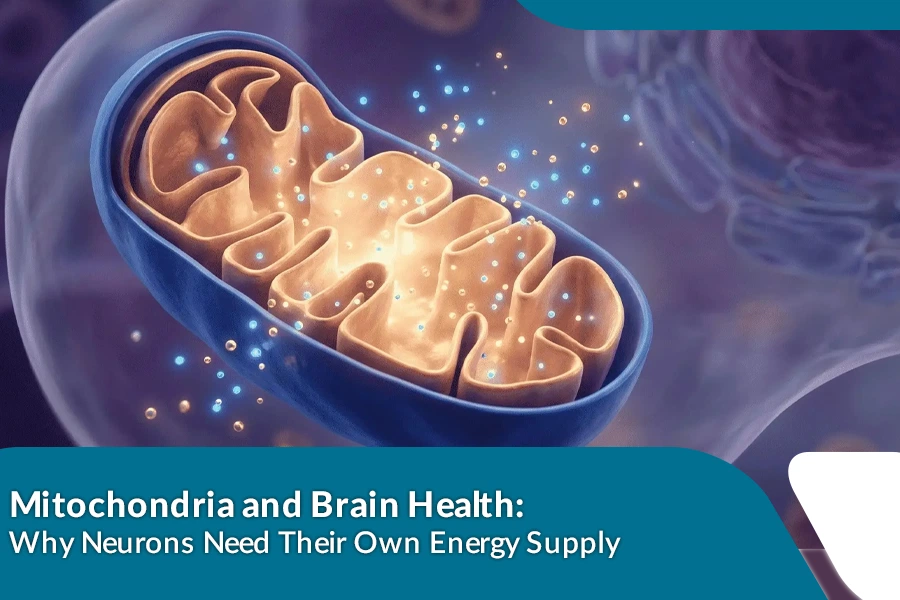
The brain makes up roughly 2% of body weight and uses something like 20% of the body’s energy. That ratio is odd when you stop and think about it. An organ that sits still, mostly, in a bony box, and yet it burns more fuel than almost anything else. Most of that fuel gets turned into usable power by mitochondria, small bean-shaped compartments inside nearly every cell. Brain health, in a fairly literal sense, depends on whether those compartments keep working.
According to science textbooks, mitochondria is “the powerhouse of the cell”, which is a bit of a cliché by now, but it is not wrong. Each one has two membranes, an outer smooth one and an inner folded one, and the folds (cristae) are where a lot of the chemistry happens. They also carry their own small loop of DNA, separate from the DNA in the nucleus. That detail still surprises people. It is usually explained by the endosymbiotic theory, the idea that an ancient bacterium was swallowed by a larger cell around two billion years ago and never left.
Food gets broken down, oxygen gets used, and a molecule called adenosine triphosphate (ATP) comes out the other end. ATP is the small change of cellular energy. Cells spend it constantly.
Neurons are not like skin cells or fat cells. A neuron sits there maintaining an electrical charge across its membrane, all the time, even when nothing much is happening. Sodium and potassium pumps push ions back and forth, and those pumps alone swallow a huge share of the brain’s ATP budget. Then add firing. Every action potential disturbs the ion balance a little, and the cell has to restore it straight afterwards. Neuron function is basically a cycle of disturbing and restoring.
And there is the synapse. Releasing neurotransmitters, packing them back into vesicles, clearing them from the gap, rebuilding receptors. All of it costs energy. Neuron energy demand is highest at synapses, which is probably why mitochondria cluster there, parked in the terminals like little generators outside a building.
Related: Role of Neurotransmitters: Dopamine, Norepinephrine & Orexin
A single neuron can be very long. Motor neurons running from the spinal cord to the foot can stretch about a metre, and the cell body is tiny compared with that. The axon is a thin cable, and energy made in the cell body cannot just diffuse down to the far end in time. ATP does not travel well. So the mitochondria themselves get transported along the axon, carried on molecular motors that walk along microtubule tracks, some going forwards, some coming back for repair or disposal.
This is what “their own energy supply” really means. Neurons cannot rely on a central power station. Each region of the cell, especially the terminals and the branching dendrites, needs a local source. When that transport system breaks, the far ends of the cell starve first. Several neurodegenerative conditions show exactly this pattern, with the longest, most demanding axons failing early.
Brain metabolism leans heavily on glucose. The brain keeps almost no fuel in reserve, so it relies on a constant delivery through the blood, plus oxygen. If that supply is interrupted for even a few minutes, as in a stroke, damage begins quickly. That sensitivity is a direct consequence of how much brain cells depend on oxidative energy production rather than on slower, less efficient routes.
Glucose is first split in the cytoplasm (glycolysis), giving a small amount of ATP. Most of the yield comes later, inside mitochondria, where the products of glucose are fed into the Krebs cycle and then the electron transport chain. Roughly 30 ATP molecules per glucose are usually quoted, though the exact figure is still argued over, and it likely varies by cell type. There is also a debated idea that astrocytes, the support cells, convert some glucose to lactate and hand it to neurons as fuel. The lactate shuttle hypothesis. Not everyone agrees on how much it matters. It may matter more during intense activity, less at rest, or maybe the reverse, and the evidence is still moving.
Cellular respiration is the umbrella term. Glycolysis, the Krebs cycle, oxidative phosphorylation. In the last step, electrons pass along a chain of protein complexes embedded in the inner membrane, and that flow pumps protons across the membrane, building a gradient. Protons then rush back through an enzyme called ATP synthase, and that is what actually produces the ATP. It works a bit like water turning a mill wheel.
Oxygen sits at the very end of the chain as the final electron acceptor. That is why oxygen matters so much, and also why the process is not perfectly clean. Electrons sometimes leak early and react with oxygen to form reactive oxygen species. Which brings up the next problem.
Oxidative stress occurs when reactive oxygen species build up faster than antioxidant defences can clear them. A small amount is normal, even useful, since these molecules act as signals. Too much damages lipids, proteins and DNA, including the mitochondrial DNA sitting very close to where the radicals are made. That proximity is a known weakness. Mitochondrial DNA has fewer repair tools than nuclear DNA, so mutations can accumulate over decades.
The brain is particularly exposed. It uses a lot of oxygen, it is rich in fats that oxidise easily, and its antioxidant defences are modest compared with some other organs. Neurons also rarely divide, so damaged ones are not simply replaced by fresh copies. Damage tends to stack up. Researchers link oxidative stress to ageing of the brain and to disorders such as Alzheimer’s disease and Parkinson’s disease, though cause and effect are still tangled, and it is not always clear whether the stress starts the decline or follows it.
Mitochondrial health and what goes wrong
Mitochondrial health is not just about how many of these organelles a cell holds. It is also about quality control. Damaged ones can be fused with healthy neighbours (fusion), split apart (fission), or removed entirely by a process called mitophagy. In Parkinson’s disease, two genes involved in mitophagy, PINK1 and Parkin, are mutated in some inherited forms. That finding pushed the idea that failure to clear faulty mitochondria can directly harm dopamine-producing neurons.
Mitochondrial function also declines with age. Membrane potential weakens, ATP output drops, and calcium handling gets sloppy. Calcium matters because neurons use it as a signal, and mitochondria help buffer it. Too much calcium inside the organelle can trigger a kind of pore opening that leads to cell death. It is a delicate balance, and the margin for error is smaller in neurons than elsewhere.
In Alzheimer’s disease, imaging studies often show reduced glucose use in certain regions years before symptoms appear. Whether this is an early cause or an early sign is genuinely unresolved. Amyloid and tau proteins both seem to interfere with how these organelles move and work, so the picture is probably circular rather than a neat line.
It is easy to treat all this as background plumbing, but cognitive function relies on it directly. Memory formation needs synaptic strengthening, which is energetically expensive. Attention and processing speed rely on rapid, repeated firing across networks. When Mitochondrial Function slips, those processes can become slower or less reliable. Fatigue, brain fog, and in more severe cases, seizures or developmental delay appear in people with inherited mitochondrial disease, which often involves the nervous system first or most obviously.
Rare genetic disorders of these organelles tend to produce neurological symptoms because the brain and nervous system are among the heaviest energy consumers. The tissues with the greatest demand are the first to show a shortfall.
Regular aerobic exercise appears to increase mitochondrial biogenesis, meaning new organelles being built, and animal studies suggest this extends to brain tissue. Sleep seems to matter for clearing metabolic waste. A diet with plenty of vegetables, fish, and whole foods is linked to better outcomes, probably in part through lower oxidative stress, though diet studies are notoriously hard to interpret. Avoiding heavy, long-term alcohol use matters too.
Supplements are a different story. Coenzyme Q10, creatine, alpha-lipoic acid and others are marketed for energy and brain support, but human trial results are mixed, and some trials in neurodegenerative disease have been disappointing. Anyone considering them should check with a doctor, especially when taking other medicines.
The overall picture is fairly consistent even if the details are not. Neurons are expensive cells, they sit far from their own supply lines, and they depend on mitochondria positioned exactly where energy is needed. Protect that machinery, or at least avoid damaging it, and the rest of the nervous system has a better chance of coping with aging. There is still a lot unknown, especially about which changes come first in disease. Which is probably why the field is so active right now.
Neurons constantly maintain electrical charge and fire signals, and both processes burn ATP at a high rate.
Cells can build new ones through biogenesis and clear damaged ones through mitophagy, though both slow with age.
Not always, since small amounts act as signals, but chronic excess damages proteins, fats and DNA.
Evidence is mixed, so it is wise to speak to a doctor before trying them.
Yes, regular aerobic activity is associated with more mitochondria, better blood flow and better cognition.

Modamindfuels is a source for detailed information on mental health and its medications, focusing on the treatment of sleep apnea, narcolepsy, and bipolar disorder. The content on this website is intended for general informational purposes only and does not constitute professional medical advice, diagnosis, or treatment. These medications may have side effects, interactions, and contraindications. We do not accept any liability for damages or injuries arising from the use of information or drugs provided on this website.