Decision Paralysis: The Hidden Cost of Having Too Many Choices
By
Dr.Liam
/ October 14, 2026
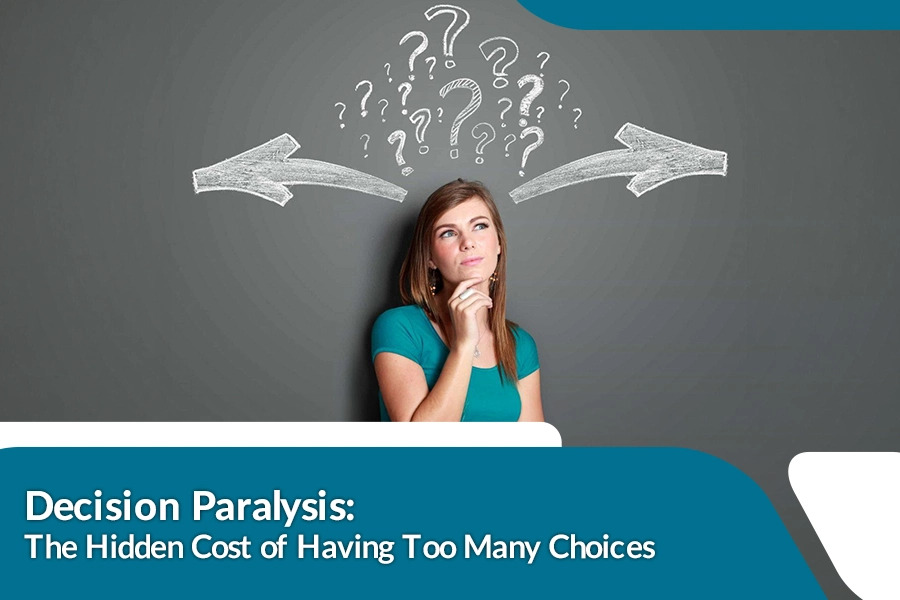
Somewhere between the fourth streaming service and the thirty-seventh pair of nearly identical running shoes, something odd happens. Choosing stops feeling like freedom and starts feeling like a chore or a small test that could be failed. Researchers have a few names for the stall that follows, and decision paralysis is the broadest one. It isn’t laziness. It isn’t quite a character flaw either, though people caught in it often describe it that way.
For a long time, economics assumed the opposite. More options could only help, since anyone could simply ignore the extras. Except ignoring work. Attention doesn’t switch off on command, and every option that gets glanced at and dismissed leaves a tiny residue behind.
What is decision paralysis?
Decision paralysis is the tendency to delay, avoid, or abandon a choice once the number of options, or the stakes attached to them, climb past what a person can comfortably weigh. Some writers use it interchangeably with analysis paralysis, and honestly the two terms get swapped all the time. If a distinction exists, analysis paralysis leans toward the research side (one more review, one more comparison spreadsheet), while the wider problem can also look like plain avoidance. Closing the tab. Saying “let’s just talk about it later.” Ordering the same meal as always, not out of loyalty, but because the menu felt like too much.
The blurry line probably matters less than the pattern. Options go up, confidence goes down, and the choice either doesn’t happen or happens badly.
The jam experiment
Almost every article on this topic mentions the jam experiment, and it’s worth mentioning again because the numbers are striking. In 2000, Sheena Iyengar and Mark Lepper set up tasting tables in an upscale grocery store. One table offered 24 varieties of jam and the other offered 6. The larger display drew more attention, with about 60% of passing shoppers stopping versus roughly 40% at the small one. But when purchases were counted, only around 3% of those who visited the big table bought a jar. At the small table it was closer to 30%.
Later attempts to reproduce the effect have been mixed. A large meta-analysis by Alexander Chernev and colleagues in 2015 found the average effect of choice overload sitting near zero across dozens of studies, but with real effects appearing under certain conditions: When the option set was complex, when people had no clear preference going in, when the task itself was hard. So the fair reading isn’t “more choice is bad.” It’s closer to “more choice is bad when people don’t already know what they want.” That’s a narrower claim, and probably a truer one.
Why the brain stalls: cognitive load
George Miller’s famous 1956 paper suggested about seven items, plus or minus two, and more recent work by Nelson Cowan puts the number closer to four meaningful chunks. Whichever figure is right, it’s not many. A choice among twenty products with six attributes each asks the mind to hold more than it can hold, so it starts dropping things, comparing unevenly, and forgetting what was ruled out ten minutes ago. That’s cognitive load in a nutshell.
John Sweller’s theory, developed in the late 1980s for learning research, describes how the mental effort of a task can exceed available capacity, and performance falls apart once it does. When the load tips past that point, the term used is cognitive overload. It doesn’t feel dramatic from the inside. It feels like fog. Reading the same product description three times and retaining nothing.
Hick’s law adds a related, slightly older idea: reaction time rises with the number of alternatives. Not linearly, more like logarithmically, but still. More options means slower decisions, even when the options are trivial.
Decision fatigue
Then there’s decision fatigue, the idea that the quality of choices degrades after a long run of making them. It’s intuitive. Most people have experienced the end-of-day state where deciding what to eat feels absurdly hard, having already made hundreds of small calls since morning.
The scientific footing is shakier than the popular version suggests. The best-known evidence is a 2011 analysis of Israeli parole judges, which found that favorable rulings dropped sharply as a session went on and then jumped back up after breaks. It made headlines. Critics later argued that case order wasn’t random, and that the pattern could partly come from how hearings were scheduled. Separately, the broader theory behind it, ego depletion, took a hit when a large multi-lab replication in 2016 failed to find the classic effect.
So where does that leave things? Probably here: mental fatigue after sustained effort is real, since anyone can feel it, but the specific idea of a single depletable “willpower tank” is on weaker ground than it was fifteen years ago. Mental exhaustion may be more about motivation, attention, and the sheer boredom of grinding through options than about running out of some fuel. Nobody knows for certain yet.
Overthinking and the maximizer problem
Barry Schwartz and colleagues published work in 2002 separating people into maximizers, who try to find the objectively best option, and satisficers, who accept the first one that’s good enough. Maximizers tended to report more regret and less satisfaction, and higher scores on measures of depression, even when they’d objectively chosen well. The search itself seemed to be the cost.
Decision paralysis shows up more often in maximizers, which makes sense. If the goal is the best possible choice, every extra option is a threat, because it might be the better one. Indecisiveness in this sense isn’t about lacking preferences. It’s often the opposite: too many standards, all active at once.
Overthinking feeds it. A choice gets replayed from every angle, then replayed again after the decision is made, which is how a two-minute purchase turns into a week of low-grade rumination. Repetition doesn’t add information, but it feels productive, which is the trap.
Where information overload comes in?
Modern life adds a layer that earlier generations didn’t face at the same scale. Ratings, reviews, influencers, comparison sites, forum threads with contradictory advice. Each source is meant to help. Together they produce information overload, a state where more input makes the picture less clear rather than more.
Take something ordinary, like choosing a laptop. The specifications alone can run to dozens of numbers. Add two hundred reviews, half of them contradicting each other, and a person can end up knowing more than ever and trusting less. That feeds decision paralysis directly, because certainty seems to be one click away, and it never quite arrives.
There’s also a quieter cost. Time spent comparing is time not spent on anything else, and it drains attention that could go toward work that matters. Over weeks, the constant small decisions (which app, which email first, which of the eleven tabs) chip away at productivity in ways that rarely get traced back to their source. Output drops and nobody can say exactly why.
What seems to help?
Reducing the option set is the obvious one. Retailers and designers have long known that curated selections convert better, and the same logic applies personally: cut the list to three before comparing anything. Setting a limit in advance also works, whether it’s a time cap or a maximum number of sources. Satisficing, meaning deciding what “good enough” looks like before the search starts, protects against the maximizer spiral. Defaults help too. Having a standard breakfast or a standard work outfit removes low-stakes choices entirely, which frees attention for the ones that count.
Sleep, food, and breaks matter, in a boring way. A tired brain does struggle with comparison tasks, whatever the fate of ego depletion theory, and stepping away often restores a certain mental clarity that staring never does.
One more thing, maybe the most useful: separating reversible choices from irreversible ones. Most decisions can be undone or adjusted. Treating a coffee order like a marriage proposal is a category error, though a very common one.
Final Thoughts
Choice is good. Nobody seriously argues for a world with fewer options. The trouble is that the human mind has a narrow bandwidth, and modern environments keep pushing well past it, so the cost shows up in small ways: stalled projects, mild dread at menus, a lingering sense of tiredness that sleep doesn’t fully fix.
Decision paralysis isn’t a defect to be ashamed of. It’s a predictable response to too much input and too little structure. The research is messy, the effect sizes vary, and some famous findings haven’t held up well. Still, the core observation keeps surviving: past a certain point, more options tend to make people slower, less satisfied, and sometimes unable to choose at all.
FAQs
What causes decision paralysis?
Decision paralysis is when you’re overthinking a decision to the point where you can’t make an informed decision.
Is decision paralysis the same as analysis paralysis?
They overlap a lot. Analysis paralysis is often associated with over-researching, but decision paralysis can also mean never making the choice.
Does decision fatigue really exist?
Mental fatigue from sustained effort is real, but the “willpower tank” theory behind it has been challenged in replication studies.
Can too much information kill your productivity?
Yes.Information overload consumes attention and slows decision making, tending to reduce output.
How can somebody decide faster ?
Set a deadline for yourself, limit yourself to three choices, and define “good enough” beforehand.