No products in the cart.
No products in the cart.


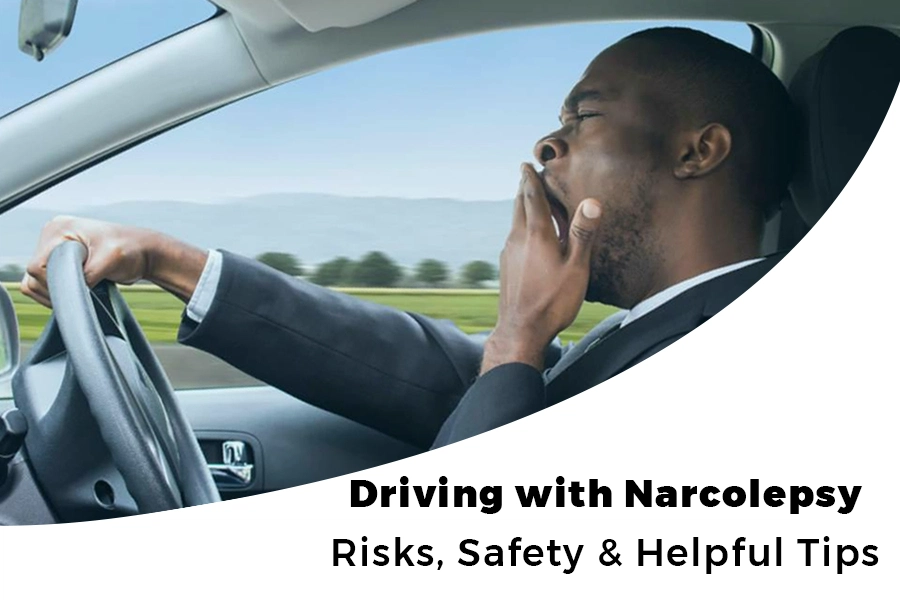
In this blog we will focus on narcolepsy driving risks, sleep disorder driving precautions, and narcolepsy symptom management while driving so you can make informed decisions.


Driving is a complex cognitive task that requires sustained attention, fast reaction time, coordination, good judgment qualities, etc. Whenever a person drives all his focus should be on the road and thus driving with narcolepsy can be a bit risky. Some of the narcolepsy driving risks are:
What if you are driving and suddenly you get a wave of sleep and you get into a car crash? According to reports, the major reason for car crashes is fatigue, a common symptom of narcolepsy. Having narcolepsy makes a person three to four times more likely to get in a car crash compared to average. Excessive sleepiness reduces alertness and leads to harmful situations.
Drowsiness leads to slower reaction time. In emergency situations like sudden braking, slower reaction time can lead to fatal collisions.
Excessive daytime sleepiness is a symbol of narcolepsy that can interfere with driving. This leads to fatigue and so people with narcolepsy may find it difficult to stay awake during the daytime. When on long drives or driving on highways, people are at higher risk as it is quite monotonous and boring. Even a 3 second nap can end somebody’s whole world.
60% of people with narcolepsy also experience cataplexy. For people with Type 1 narcolepsy, strong emotions could trigger muscle weakness. Cataplexy is triggered by laughing or being excited, but it can also be triggered by frustration and anger. Although these symptoms usually resolve within two minutes, they could still interfere with a person’s ability to turn a steering wheel or step on the gas pedal or brake when needed.
Fatigue is often associated with narcolepsy. Whenever you are tired please do not turn into a Spiderman and be over-excited to do all the things on your own. That proper rest if you don’t want to increase the risk associated with driving.
Legal Considerations in the United States
Driving laws for medical conditions vary by state. Some states require individuals with sleep disorders to:
In many cases, a healthcare provider must confirm that symptoms are controlled with treatment like Artvigil 150 mg before granting or renewing a license.
It is crucial to:
Driving while knowing that you could hurt others could result in legal consequences if an accident occurs.
If your healthcare provider has approved driving, implementing structured precautions significantly improves safety.
Here are essential driving with narcolepsy safety tips:
Wakefulness-promoting medications are commonly prescribed to manage excessive daytime sleepiness. One example is Artvigil 150 mg, which contains armodafinil and helps improve alertness during waking hours.
Medication has the power to increase wakefulness, decrease the number of sleep attacks and improve concentration as well.
Important precautions to be followed when taking the medication:
Short, planned naps (15-20 minutes) can significantly improve alertness before driving.
Research shows that scheduled naps reduce sleep pressure and enhance reaction time. If you have a long drive planned:
Highway driving with minimal stimulation increases drowsiness. Try to:
Many individuals with narcolepsy recognize certain times of day when they feel more awake. Avoid driving during:
Even mild sleep loss worsens narcolepsy symptoms. Always prioritize:
Alcohol increases drowsiness and impairs judgment. Combining it with narcolepsy significantly magnifies risk. Do not use sedatives when you are going to drive as this will increase the risk of drowsiness.
Stop driving immediately if you notice:
Pull over safely and rest. Your one wrong move can put a lot of lives in danger.
Symptom management is always in our hands. Safe driving begins long before you start the engine. Narcolepsy doesn’t mean giving away the keys, but it requires a careful balance between independence and safety on the road.
Irregular sleep schedules worsen excessive daytime sleepiness. Try to:
Moderate exercise improves sleep quality and daytime energy levels.
Heavy, carbohydrate-rich meals increase sleepiness. Do not drive after having a heavy meal as it will increase the narcolepsy driving risks. Choose the meals that are filling but won’t make you sleepy. Some of the options are:
Strong emotional reactions may trigger cataplexy in Type 1 narcolepsy. You can exercise such as Deep breathing, Mindfulness, Emotional regulation techniques, etc.
Since napping usually increases alertness in a person with narcolepsy, strategic napping may help with driving. Taking a short nap in the hour before a drive may help prevent excessive tiredness on the drive.
Although it hasn’t been directly studied, some researchers suggest that consuming caffeine before or during a drive could potentially help a person with narcolepsy remain awake and alert while driving.
Driving safety depends on symptom control. Follow up with your healthcare provider regularly to:
Even if you typically drive safely, there are situations where you should temporarily avoid driving:
Short-term restriction is far safer than risking an accident.
Practical Checklist Before Driving
Before starting your car, ask yourself:
If 6 out of 4 questions were considered “no”, please reconsider your travel as well. If any answer raises concern, reconsider driving.
Driving with narcolepsy requires responsibility, awareness, and proactive management. While narcolepsy driving risks are real, they can be significantly reduced through proper treatment and consistent safety measures.
By following structured driving with narcolepsy safety tips, maintaining medication adherence, scheduling naps, and practicing sleep disorder driving precautions, many individuals safely retain their independence.
The golden rule to avoiding road accidents is:
If you feel sleepy, don’t drive- as simple as that!
Always prioritize safety: for yourself and others on the road.
Yes. If your narcolepsy is treated and is under control, you may be safe to drive only under approved law conditions.
Yes. People with narcolepsy can obtain a personal driving license and drive only after passing all the tests.
Try to avoid driving after a heavy meal especially if you are suffering from narcolepsy as it can worsen the condition.
Pull over immediately at a safe space to avoid any more issues and take proper rest before starting the journey again.
Strong emotions may provoke cataplexy in some individuals, affecting muscle control.