Why Do I Have Trouble Concentrating When I’m Tired?
By
Dr.Liam
/ October 22, 2026
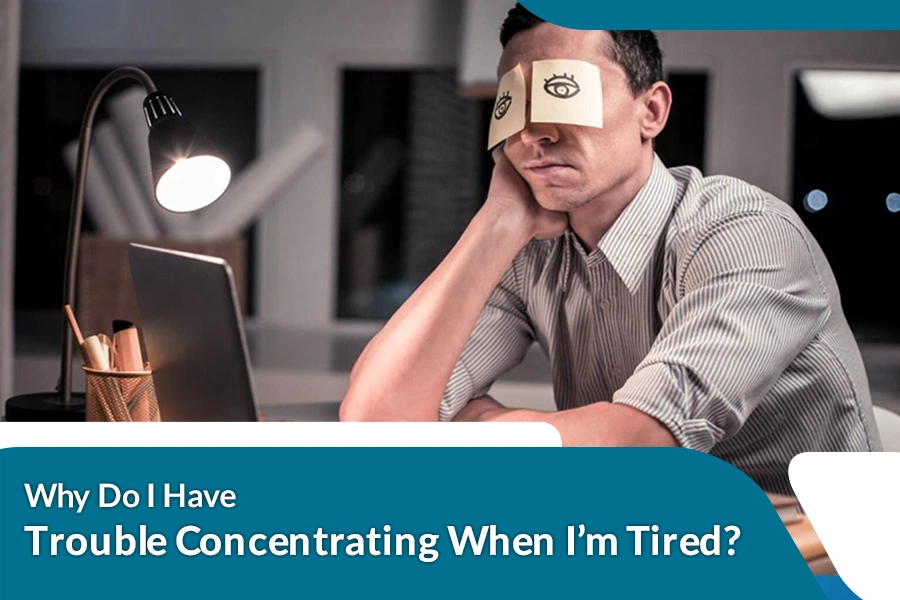
There’s a specific kind of tiredness where the same sentence gets read four times and nothing sticks. The eyes move, the words go in, and nothing comes out the other end. Most people know this feeling well, and most blame themselves for it, which is a bit unfair, because what’s happening is mostly biology and not a character flaw.
Concentration isn’t one single thing
People talk about concentration like it’s a switch, on or off. It isn’t. It’s a bundle of things the brain does at once: holding a goal in mind, ignoring junk, noticing when attention drifts, and pulling it back. Each of those leans on slightly different circuitry, and tired brains seem to lose them unevenly, so one hour a person can be fine at email and useless at anything needing real thought.
Researchers who study sleep loss often describe the effect as a general slowing, but that’s a little too tidy. In lab studies the slowing is patchy. Reaction times look okay for a few minutes, then a big gap appears, then things look okay again.
Related: Why My Brain Feels Tired Signs Causes And Smart Solutions
The prefrontal cortex gets hit first
The prefrontal cortex, the front part of the brain behind planning, decision-making and impulse control, appears to be especially sensitive to missing sleep. Imaging studies have shown reduced activity there after a night without sleep, while other regions, like those handling basic sensory input, hold up better. So the brain still sees and hears fine. It just struggles to do anything sensible with what comes in.
That’s a big part of why sleep deprivation focus problems feel so strange. Nothing is “broken.” The person can still talk, still walk, still follow a conversation in a loose way. But holding a thought steady for ten minutes? Much harder. And the harder the task, the more obvious the drop.
Some of the compensation also gets weird. Brain scans in sleep-deprived volunteers sometimes show other areas lighting up more than usual, as if the brain is recruiting backup. It works for a while. Then it doesn’t.
Adenosine, the boring chemical behind a lot of it
Every hour awake, a compound called adenosine builds up in the brain. It’s a by-product of energy use, and the more of it there is, the stronger the pressure to sleep. This is sometimes called sleep pressure, and it’s the reason a person gets drowsier the longer they’ve been up.
Adenosine doesn’t just make someone sleepy in a vague sense. It dampens activity in the neurons that keep the brain alert. So the feeling of mental fatigue isn’t only psychological, it’s partly chemical, a gradual turning-down of the volume on wakefulness systems. Sleep clears it away. Caffeine blocks the receptors it binds to, which is why coffee works but doesn’t actually remove the adenosine. It just stops the brain from noticing it for a few hours.
That last point matters more than it sounds, and it comes back later.
Microsleeps, which sound made up but aren’t
When someone is badly sleep-deprived, the brain can slip into brief episodes of sleep lasting a second or a few seconds, even with eyes open. These are called microsleeps. The person often doesn’t know it happened. They just notice a gap, a missing chunk, like a skipped frame in a video.
Attention lapses are the everyday version of this. Not full microsleeps necessarily, but short breaks in responsiveness. Psychomotor vigilance tests, a standard lab tool where people press a button when a light appears, show it clearly: after poor sleep, the slowest responses get a lot slower, and the occasional “miss” becomes common. The average doesn’t change as much as the worst moments do. That detail is easy to overlook, but it’s probably the most important one. Tired performance isn’t just a bit worse across the board. It’s unreliable.
Working memory fatigue and why simple tasks get hard
Working memory is the mental scratchpad, the space used to hold a phone number while dialing it, or to remember the start of a paragraph by the time the end arrives. It’s limited even in well-rested people, and it gets noticeably smaller when sleep is short.
Working memory fatigue shows up in small, irritating ways. Walking into a room and forgetting why. Losing the thread of a sentence halfway through saying it. Re-reading the same email because the first half evaporated while reading the second half. These aren’t signs of something sinister. They’re what a reduced scratchpad looks like in daily life.
There’s also evidence that tired brains struggle to filter distractions. Normally, irrelevant stuff gets quietly suppressed. With less sleep, more of it leaks through, so the buzzing phone and the noise in the hallway all compete with the task. Concentration then has to work against more interference with fewer resources, which is a rough combination.
Sleep debt effects don’t just reset overnight
A common assumption is that one long sleep on the weekend fixes everything, may it be anything related to concentration or working memory. Sometimes it helps. But research on chronic partial sleep restriction, such as getting six hours a night for two weeks, suggests the effects pile up, and that people often stop noticing how impaired they are. Subjective sleepiness levels off while performance keeps dropping.
That mismatch is arguably the odd part. In a well-known set of experiments, volunteers limited to around six hours a night performed about as poorly, after a couple of weeks, as people who’d stayed up for a full night or two. Yet they rated themselves as only slightly sleepy.
So sleep debt effects may be hiding in plain sight. A person can feel “fine, just a bit tired” and still be dropping balls, missing details, and taking longer on everything. Recovery also seems slower than the debt accumulated, though the exact timeline is still debated, and probably varies between individuals.
Related: What Is Sleep Debt? How Lost Sleep Adds Up Over Time
Circadian rhythm and alertness decline
The body clock matters here too, and it’s separate from how long someone has been awake. Most people have a natural dip in alertness in the early-to-mid afternoon, and another, deeper one in the small hours of the morning. Concentration decline gets worse when a poor night’s sleep lines up with one of those dips.
This is why the post-lunch slump feels brutal after a bad night but is only mildly annoying after a good one. And it’s also why shift workers, or anyone forced to work against their body clock, tend to struggle with focus even when they technically got enough hours. Timing counts, not just quantity. Though quantity matters a lot, obviously.
Light exposure, meal timing, and regular wake-up times all nudge the clock. Not dramatically. But enough that a messy schedule can mimic the effects of poor sleep on its own.
Related: How Circadian Rhythms Influence Your Brain Throughout the Day
Cognitive fatigue isn’t exactly the same as being sleepy
This is a distinction that gets blurred a lot. Sleepiness is the drive to sleep. Cognitive fatigue is what happens after sustained mental effort, even in someone who slept fine. Long stretches of demanding work seem to deplete something, whether that’s neurotransmitters, glucose availability in certain regions, or just motivation signaling. The research is honestly not settled on the mechanism.
But the two overlap. A tired person doing hard mental work experiences both at once, and each makes the other worse. Tired brain function declines faster under high demand, which is why a boring task can feel doable at 4 pm after a short night while a complex one feels impossible. Low-demand work doesn’t expose the deficit as much.
Which is a slightly annoying fact, because it means people may only notice how impaired they are when something difficult lands on their desk.
Caffeine helps
Caffeine reliably improves concentration, vigilance and reaction time in tired people. That part is well supported. What’s less clear is how much it helps with the higher-level stuff, like complex reasoning, creativity, or judgment. Some studies show benefits, others show it mostly patches the basic alertness layer and leaves the rest shaky.
There’s also the borrowing problem. Because caffeine masks adenosine’s effects without removing it, the sleep pressure is still there when the caffeine wears off, sometimes with a bit of a crash. And caffeine taken late in the day can cut into the next night’s sleep, which feeds the whole cycle again. Not a reason to avoid coffee, just a reason not to treat it as a replacement for sleep.
What actually seems to help
Nothing dramatic here, and that’s sort of the point. Short naps, around 10 to 20 minutes, can restore alertness without causing heavy grogginess. Longer ones risk sleep inertia, that foggy feeling on waking. Bright light, particularly in the morning, helps anchor the body clock. Brief movement, like a short walk, tends to give a temporary lift in alertness too.
For tasks that really need concentration, scheduling them at a person’s personal peak, often late morning for many people, tends to beat forcing them into the slump. And breaking work into smaller chunks can reduce the load on a depleted working memory.
Still, the fix that works best is the obvious one, and the least satisfying: more sleep, more consistently. Seven to nine hours is the standard recommendation for adults in the US health guidance, and while individual needs vary, many people run well below that for months and call it normal.
When it might be more than just being tired
Persistent trouble with focus, even after decent sleep, can point to other things. Sleep apnea, depression, anxiety, thyroid problems, anemia, ADHD, and certain medications can all affect attention. If the fog lingers for weeks regardless of rest, or comes with loud snoring, gasping at night, or mood changes, a physician is worth seeing. It’s probably nothing exotic, but it’s the sort of thing that’s easy to put off for years.
FAQs
Why does being tired make it hard to focus?
Sleep loss reduces activity in the prefrontal cortex and builds up adenosine, which together weaken attention and working memory.
Can one bad night really affect concentration that much?
Indeed, even a single short night can cause impaired reaction times and increased number of attention lapses especially on difficult tasks.
Does caffeine fix sleep deprivation focus problems?
Partly. It improves alertness, but it doesn’t fully restore complex cognition or clear the underlying sleep debt.
How long does it take to recover from sleep debt?
It varies, but recovery often takes several nights of good sleep, and sometimes longer after weeks of restriction.
When should someone see a physician about poor concentration?
If your concentration issues don’t go away after a good night’s sleep or if you snore heavily, have a low mood or feel drowsy during the day, see a physician.