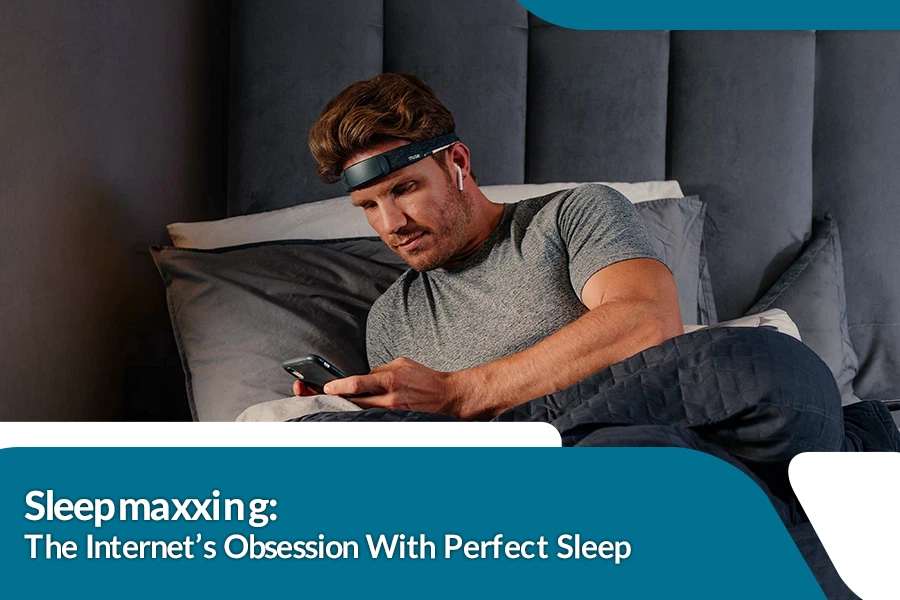
Somewhere between mouth tape and magnesium gummies, sleep turned into a competitive sport. The trend has a name now, sleepmaxxing, and it shows up on TikTok, Reddit threads, podcasts, and the wellness aisles of Boots and Target. The idea is simple enough: treat rest like a performance metric and squeeze every last drop out of it. Whether that works is a different question and a messier one than most of the videos let on.
What Is Sleepmaxxing?
The term borrows from the “-maxxing” internet trends, where any part of life can be pushed to its limit, like looksmaxxing or gymmaxxing. Sleepmaxxing is the same energy pointed at the bedroom. People stack routines, gadgets, supplements, and rules, all aimed at waking up feeling like a different species.
Some of it is old advice in new packaging. Dark room, cool room, no screens before bed. Sleep researchers have been saying versions of this since the 1970s, when the term sleep hygiene was coined. Other parts are newer and stranger: mouth tape, red-light bulbs, tart cherry shots, sleepy-girl mocktails, wearable rings that grade the night like a school report.
Most of this isn’t harmful. The trouble is that the line between useful and ridiculous gets blurry fast, and nobody scrolling at 11:40 pm is checking the citations.
The Boring Science Part (Sleep Architecture)
A night of sleep isn’t one flat block. It moves in cycles of roughly 90 minutes, and each cycle passes through lighter stages, deep sleep, and REM sleep. Deep sleep, also called slow-wave sleep, clusters in the first half of the night. That’s when the body does a lot of physical repair, and it’s tied to growth hormone release and, probably, some clearing of metabolic waste from the brain. REM sleep gets longer toward morning, and it’s linked to emotional processing and certain kinds of memory consolidation.
This matters because a lot of sleepmaxxing content chases “more deep sleep” or “more REM” as if they were separate dials. They aren’t quite. Cut the night short by an hour or two and REM takes the biggest hit, since it’s stacked at the end. Drink alcohol before bed and REM tends to be suppressed early on, then rebounds in a fragmented way later. So the total amount of sleep, and how consistent it is, ends up doing most of the heavy lifting.
Adults generally need somewhere between seven and nine hours. Both the CDC in the US and the NHS in the UK land in that range. Some people function on a bit less, but far fewer than think they do. The true short sleepers, the ones with genetic variants that let them thrive for six hours, are rare.
Light, Heat, and the Body Clock
The circadian rhythm is the master schedule, and it runs on light. Bright light in the morning pushes the clock earlier and makes the evening sleepy signal arrive on time. Bright light late at night does the opposite. This is probably the single best-supported piece of the whole trend, and it costs nothing. Go outside within an hour or so of waking, even when it’s grey, which in the UK is most of the time.
Temperature is the other big lever. Core body temperature drops as sleep approaches, and a bedroom around 16 to 19℃ (roughly 60 to 67℉) tends to suit most people. A warm bath an hour or two before bed sounds backwards, but it works because the body sheds heat afterward and the temperature drop nudges sleep onset along.
Melatonin supplements get a lot of attention here. It’s a timing signal, not a sedative, and that’s why low doses often work as well as high ones.
Related: Circadian Rhythm Disorders Symptoms Treatment
Sleep Tracking and the Anxiety Problem
Wearables changed everything. A ring or watch now offers a nightly score, a breakdown of stages, heart rate variability, and a little chart that either flatters or scolds. Sleep tracking can be genuinely useful for spotting patterns, like how a late meal shifts resting heart rate or how a run of late nights piles up.
But accuracy has limits. Consumer devices estimate sleep stages using movement and heart rate, and when compared to lab polysomnography, they’re decent at telling sleep from wake and considerably shakier at separating light, deep, and REM. The numbers are approximations, not measurements.
There’s a name for what happens when the score becomes the goal: orthosomnia. Sleep researchers coined it in 2017 to describe people so preoccupied with perfect tracker data that their sleep got worse. The logic is almost funny. Trying hard to sleep is arousing, and arousal is the opposite of sleep. A poor score then triggers worry, worry triggers more wakefulness, and the next night’s score is worse still.
A reasonable rule of thumb from clinicians: if the tracker makes a person feel worse than the actual night did, the tracker is the problem.
Sleep Hacks: What Holds Up and What Doesn’t
Not all sleep hacks are equal, and the evidence is lopsided.
The consistent winners are dull. A regular sleep schedule, meaning similar bed and wake times including weekends, is probably the strongest behavioural lever there is. Irregular timing, sometimes called social jet lag, is associated with worse mood, weight gain, and metabolic trouble in observational studies. Caffeine has a half-life of around five to six hours, so a 3 pm coffee is still partly in the system at bedtime for a lot of people. Cutting off caffeine by early afternoon is a small change with a fairly large effect for the sensitive.
Magnesium glycinate has small studies behind it, mostly modest, and people who are deficient may benefit more than those who aren’t. Glycine, before bed, showed some effects on subjective sleep quality in small trials. Tart cherry, which contains a bit of melatonin, has a couple of small studies too. None of these are miracle cures, and the effect sizes are usually small.
Mouth taping is the standout. Some ENT specialists and sleep physicians have raised concerns, particularly for anyone with blocked nasal passages or undiagnosed sleep apnoea, and a 2022 review found very little quality evidence that it helps. Blue-light-blocking glasses have been studied a lot, and the most recent large reviews found little to no benefit for sleep. Screens probably keep people up more because of the content, the stimulation, and the lost time than because of the wavelength.
Related: Sleep Smarter Focus Harder The Hidden Key to Mental Performance
Building the Sleep Environment
The bedroom counts more than most people assume. Noise, light, temperature, and comfort all feed into how long it takes to fall asleep and how many times the brain surfaces during the night without anyone noticing.
Light leaking around curtains matters, and so does the tiny standby LED on a TV. Even dim light through closed eyelids can affect sleep depth slightly. Blackout curtains or an eye mask are cheap fixes. For noise, consistent sound like a fan or brown noise can mask sudden disturbances, though the research on white noise is mixed and some studies suggest it may reduce certain sleep stages, so it isn’t obviously free of trade-offs.
Bedding is probably overrated in the influencer world. A mattress that isn’t painful is fine, and a very expensive one won’t rescue a chaotic schedule. It’s the pattern of the bedroom that counts: bed for sleep, not for scrolling emails or arguing about the group chat. Stimulus control, as it’s called in cognitive behavioural therapy, is built on the idea that the brain learns associations.
The Bedtime Routine Question
A bedtime routine is less about any specific ritual and more about giving the nervous system a runway. Dim lights, low activity, something predictable. Reading a real book, stretching, a warm shower, a few pages of something dull. The exact activity matters far less than doing roughly the same thing at roughly the same time.
Some routines online run to twelve steps and a full hour. That’s fine if it’s enjoyable, but it can quietly turn into another performance to complete, and then a stressor. A ten minute routine that actually happens beats an elaborate one that gets abandoned by Thursday.
Worry has a place here too. People who lie awake running through tomorrow’s to-do list may do better writing the list down earlier in the evening. A small trial at Baylor University found that people who wrote a to-do list for five minutes before bed fell asleep faster than those who journaled about completed tasks. It’s a single study, and small, but the logic is sensible.
When Sleep Optimization Backfires
There’s a tension buried in the whole trend. Sleep is a biological process that happens best when it isn’t being managed. Sleep optimization treats it like a project, and projects come with pressure, metrics, and failure states.
CBT for insomnia, which is the first-line treatment recommended by both the American College of Physicians and NICE in the UK, actually does something almost opposite to maxxing. It often restricts time in bed, loosens the fixation on outcomes, and teaches people to tolerate a bad night without catastrophising. The results are strong, often better than sleeping pills over the long run.
And there’s the uncomfortable point that persistent trouble sleeping isn’t always a habit problem. Snoring, gasping, restless legs, chronic pain, depression, anxiety, thyroid issues, and sleep apnoea can all wreck a night, and no amount of magnesium or red bulbs fixes them. If someone is exhausted despite eight hours in bed, that’s a job for a physician rather than a product.
Is sleepmaxxing worth it?
Probably, in small doses. The sensible parts of sleepmaxxing amount to good sleep health in a trendier outfit: a steady sleep schedule, morning light, a cool dark room, less late caffeine and alcohol, and a calm wind-down. Those changes have real evidence behind them, and most of them are free.
What the research doesn’t support is the idea that perfect sleep exists, or that a score of 95 every night is normal. Sleep varies. A rough night now and then is part of being a person, and the body is quite good at compensating, especially if the next night is reasonably normal.
The healthiest version of the trend might be the least visible one, where the habits become boring and automatic and nobody posts about them.
FAQs
It is an internet trend focused on optimizing sleep through routines, gadgets, supplements, and environment tweaks. Some of it is evidence-based, and some of it isn’t.
Does sleep tracking actually improve sleep quality?
It can help spot patterns, but consumer devices are only approximate at measuring sleep stages. For some people, obsessing over scores makes sleep worse.
Is mouth taping a safe sleep hack?
Evidence is thin, and physicians have raised concerns, especially for anyone with nasal blockage or possible sleep apnoea. It’s best to talk to a clinician first.
When should someone see a physician about sleep?
If sleep problems last more than a few weeks, or come with loud snoring, gasping, or heavy daytime tiredness, get it checked.
Sleepmaxxing can be bad when it turns into an obsession for the perfect routine which can turn into anxiety, stress, etc.