Spacing Effect vs Cramming: Why Your Brain Prefers Learning Over Time
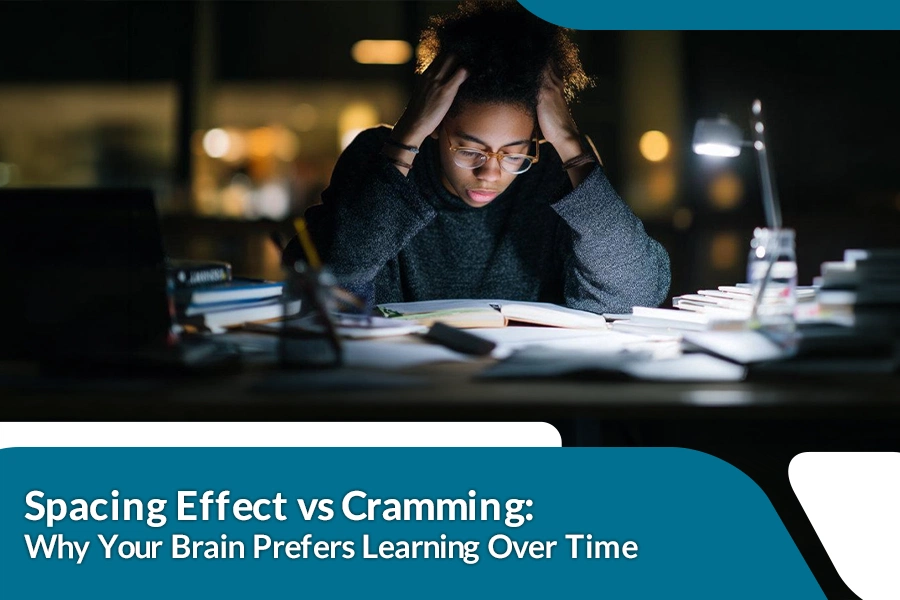
Picture something like that: You have a test tomorrow and you are trying to memorize 30 new words tonight. By the next day how many words are you going to remember? 10? 20? Or 30?
Now picture a different approach: You learn those same words across several days. You keep on revisiting those words, use them in sentences and hear them again in a conversation. Later, due to consistent usage these words feel similar and then natural.
According to a research by a German psychologist Hermann Ebbinghaus, “Spreading study time across multiple smaller sections helps the brain retain information much better than studying everything in cramming”.
What is the spacing effect?
The spacing effect is the psychological behavior that helps your brain to learn and remember the information much better when you spread study sessions over the time instead of cramming them inside the block.
The spacing effect is this finding in memory research; goes back over a century actually, Hermann Ebbinghaus was messing around with nonsense syllables and his own memory in the 1880s-that says information gets encoded more durably when study sessions are spread out over time rather than crammed into one sitting. Spaced practice, distributed practice, same idea, different labels depending on which textbook you grabbed.
The weird part, and this is the part that trips people up, is that spacing feels worse while you’re doing it. Cramming feels productive. You sit down, you grind through the material, it feels fresh, you nail the practice questions right after. Spacing feels like you’re forgetting things constantly, because you are, that’s sort of the point, and it’s uncomfortable in a way cramming isn’t.
The forgetting curve
Ebbinghaus also came up with the forgetting curve, which is a graph showing how quickly memory fades after learning something, and it’s steep, like alarmingly steep in the first day or two, then it flattens out. Most of what you “learn” in a single sitting is gone within 24 to 48 hours if nothing reinforces it.
Every time you revisit the material, especially right around the point where you’re about to forget it, the curve resets but flatter. Slower decay next time. Do that enough times and the memory sticks around for a genuinely long while. This is sort of the whole mechanism behind spaced learning apps, the flashcard ones that show you a card right before you’re statistically likely to forget it.
Doesn’t always work perfectly in practice though. People’s forgetting rates vary a lot, and the “ideal” interval isn’t some fixed formula despite what a few apps might imply with their clean little algorithms.
Why does cramming feel like it works?
Cramming isn’t useless, to be fair. If there’s a test tomorrow and nothing exists after that, cramming can absolutely get you through it. Short-term recall spikes. The brain’s working memory holds onto stuff decently well for a few hours, sometimes a day. That’s real.
The problem is long term memory basically never gets built. Cramming skips the consolidation process-sleep plays a huge role here actually, memory consolidation happens a lot during sleep, and if you’re cramming until 3 am you’re cutting into the exact window your brain needs to lock things in. So you walk into the test running on fumes and shallow recall, pass it, and then two weeks later you couldn’t explain the material to save your life.
There’s also this thing where cramming creates an illusion of mastery. Because the info was just reviewed, it feels familiar, and familiarity gets mistaken for actual learning. Psychologists call this a “fluency illusion” I think, or something close to that name-the point is, feeling like you know something and actually knowing it are not the same, and cramming blurs that line badly.
Related : Sleep vs Cramming What Actually Improves Exam Performance
Retrieval practice
Spacing alone isn’t the whole story though, and this bugs me a little when spacing gets talked about like it’s the single fix for everything. Retrieval practice matters just as much, maybe more. That’s the active recall part, actually trying to pull information out of memory, like with practice questions or flashcards, rather than just rereading notes.
Rereading feels like studying. It kind of isn’t, not efficiently anyway. Active recall is harder, feels worse in the moment , but it strengthens memory way more per minute spent.
Combine spacing with retrieval practice and you get what a lot of memory retention researchers consider close to the gold standard for durable learning. Spaced repetition of retrieval attempts. Not just spaced rereading. That distinction gets lost sometimes in how this stuff gets simplified online.
How spacing plays out for real people, not lab conditions?
Lab studies are neat and controlled, intervals precisely timed, nonsense syllables or word lists, very clean data. Real studying isn’t like that at all. Life gets in the way, intervals get messy, someone studies Monday, meant to study Wednesday, ends up doing it Friday instead because work happened.
Turns out and this is somewhat reassuring-spacing still helps even when it’s imperfect. The benefit isn’t some precise formula that collapses if you’re on a day off schedule. Rough spacing beats no spacing. Doesn’t need to be exact. Which is good because nobody’s life runs on a study schedule that precise anyway.
Also, longer material benefits more from spacing than short simple facts, generally speaking. Learning someone’s name, spacing barely matters. Learning organic chemistry mechanisms for a semester-long exam, spacing matters enormously, because the material is layered and needs multiple passes to actually connect.
Some practical mess, not a clean system
There’s no single right interval, despite certain apps pretending there is. Some research points toward expanding intervals-study today, then two days later, then a week later, then a few weeks later: each gap slightly bigger than the last. Other research suggests fixed spacing works nearly as well and is a lot less mentally taxing to plan. Both camps have decent evidence behind them honestly, so picking one isn’t really a wrong move.
What seems to matter more than the exact interval is just… not letting a single study session be the only exposure to the material. Twice is already miles better than once. Three or four spaced sessions and you’re in genuinely strong territory for long-term memory, especially paired with some form of self-testing rather than passive review.
None of this means cramming should get treated like some moral failure either. Sometimes there isn’t time. Sometimes cramming is the only realistic option given how a week went. It’s just worth knowing what cramming actually buys short-term performance, not durable knowledge so at least the tradeoff is a conscious one instead of an accidental one.
Why does the brain work this way?
There’s some theorizing, not fully settled, about why spacing beats massed practice at a mechanistic level. One idea is that spacing forces the brain to reconstruct memory traces from a slightly weaker starting point each time, and that act of reconstruction of working a little to retrieve something partially faded is what strengthens the trace. Cramming never asks the brain to do that reconstructive work because everything’s still fresh and easy to access.
Another angle is contextual variability; spaced sessions naturally happen in slightly different mental states, times of day, moods, and surroundings, and that variability gets tied to the memory, making it accessible through more retrieval paths later. Cramming happens in one context, one mental state, so there’s only one narrow path back to that memory afterward.
Neither explanation is fully proven, both get cited a lot, and probably some combination of the two, plus other stuff nobody’s figured out yet, is what’s actually going on.
Where this leaves things
The spacing effect isn’t some magic hack, it’s honestly just a slower, less satisfying way to study that happens to work a lot better than the fast satisfying way. That’s kind of an annoying thing to accept. Cramming will probably never fully go away because deadlines are deadlines and sleep gets sacrificed and that’s just how school and work sometimes go. But knowing the difference, knowing that one path builds something that lasts and the other basically evaporates-seems like it’s at least worth factoring in before the next all-nighter happens.
FAQs
What is the spacing effect in simple terms?
It’s the finding that spreading study sessions over time helps memory stick better than cramming everything at once.
2. Is cramming completely useless?
No, it works okay for short-term recall, like a test the next day, but it fades fast afterward.
3. How long should study gaps be for spaced practice?
There is no hard and fast rule but slowly increasing the intervals over days or weeks tends to work well.
4. Does spacing work better with active recall?
Yes, combining spaced sessions with retrieval practice, like self-testing, builds much stronger long term memory.
5. Why does cramming feel like it’s working even when it isn’t?
It’s because the familiarity of the recent reviews gives an illusion of mastery that doesn’t hold up over time.