No products in the cart.
No products in the cart.


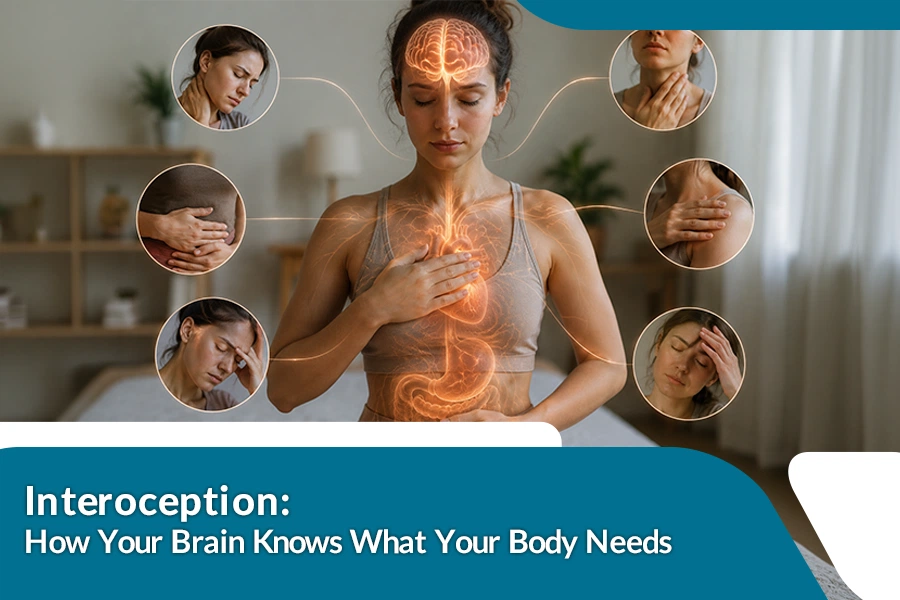
Have you ever felt your head pound? Your heart race? Your palms sweaty? Your stomach growls? Your eyes go heavy suddenly? All these signs are noticed by many people with an important sense. We usually have studied that we have just 5 sensory systems namely Touch, Sight, Smell, Taste and Hearing. What if I tell you that there are 8 sensory systems? There are inside senses that live within the body: Vestibular sense, Proprioception and Interoception. Interoception rarely gets mentioned even though it might be doing more constant work than any of them.
Interoception is the sense that tells the brain what’s happening inside the body: heartbeat, breathing, hunger, thirst, that tight feeling in the chest before a panic spiral, the vague unease of needing the bathroom before you’ve consciously registered it. The signals arrive mostly as raw data. Heart rate might go up, Blood sugar drops, Cortisol spiked. The brain then has to interpret what that means, and this interpretation part is where things get difficult. A racing heart could mean fear, excitement, too much coffee, or the early stage of a fever. The body doesn’t hand over a neat label. The brain guesses, based on context, memory, and whatever story it’s already telling itself.
This is sort of why two people can have the same physical sensation and describe totally different experiences. One person’s racing heart before a presentation feels like “I’m dying.” Another person’s racing heart in the same situation feels like “I’m pumped.” Same internal body sensations, different interpretation. That’s interoception colliding with everything else the brain is doing.
The internal signaling system isn’t always accurate and it’s definitely not always loud. Some people walk around with strong, clear internal signals. They know exactly when they’re hungry, when they’re tired, when they’re anxious versus just cold. Other people have this signal running quiet, almost muffled, like the volume knob got turned down somewhere along the way.
There’s research by Sarah Garfinkel along with Hugo Critchley suggesting that people vary a lot in how well they can detect their own heartbeat without checking a pulse. Some can count it almost perfectly just sitting still. Others are basically guessing. This isn’t about intelligence or willpower, it’s more like… calibration. And that calibration seems tied to emotional regulation too, which is interesting because it means the connection between interoception and emotions isn’t metaphorical. It’s structural.
Related: Staying Mentally Sharp When Your Body Clock Is Off
People with anxiety disorders often report heightened awareness of bodily sensations-but not in a good way. It’s less “I’m well-tuned into my body” and more “every flutter feels like a five-alarm fire.” The brain and body connection there isn’t broken exactly, it’s overactive, or maybe misfiring on interpretation. A stomach gurgle becomes nausea, nausea becomes dread, dread becomes a full anxiety spiral in under ninety seconds.
On the flip side, alexithymia (difficulty identifying and describing emotions) is linked with the opposite pattern-dulled interoceptive awareness. People can’t quite locate what they’re feeling inside their body, so emotions come out foggy, hard to name, sometimes expressed physically instead (stomachaches, tension, fatigue) because the brain doesn’t have language for what’s happening underneath.
So you’ve got two failure modes almost. Too loud and too quiet. And most people sit somewhere in between, not thinking about any of this until something forces the issue-an illness, a panic attack, a meditation retreat, whatever.

Can’t really write about this without mentioning the gut-brain stuff, even though it’s become a bit of a buzzword at this point. The vagus nerve carries a huge amount of interoceptive information from the digestive system up to the brain; some studies say the majority of vagal fibers are actually going upward (gut to brain) rather than downward. Which flips the old assumption that the brain is always the one in charge, sending orders down.
Serotonin production happens mostly in the gut, not the brain, which people love to bring up in conversations about mood and diet. It’s true, though it gets oversimplified constantly-gut serotonin doesn’t cross into the brain the same way, so the actual causal chain from “gut health” to “feeling happy” isn’t as direct as wellness content makes it sound. Still, the gut clearly talks to the brain constantly, and interoceptive signals from there shape mood more than people realize.
Interoceptive awareness is the actual skill of noticing and correctly interpreting internal body sensations that seem trainable. Practices like body scanning, certain forms of mindfulness meditation, even things like yoga or breathwork, show up repeatedly in research as ways people improve their internal signal detection over time.
It doesn’t mean that it fixes anxiety or eating disorders or whatever overnight, that’s not the claim. But there’s decent evidence that people who practice attending to bodily sensations without immediately reacting to them get better at telling the difference between, say, hunger and boredom, or anxiety and excitement, or tiredness and sadness. Which sounds small until you realize how much daily decision-making runs on misreading those signals.
Disrupted interoception (not accurately sensing hunger or fullness cues) shows up as both a symptom and possibly a contributing factor in conditions like anorexia. The body’s signals get overridden repeatedly until the brain stops trusting or even receiving them clearly. Reversing that isn’t quick.
Related : Role of Neurotransmitters: Dopamine, Norepinephrine & Orexin
Most people aren’t going to sit around thinking about their insular cortex. Fair enough. But interoception quietly shapes decision-making, emotional reactions, even things like gut instinct . The brain body connection isn’t some abstract wellness concept-it’s the actual mechanism by which internal states become conscious feelings, which then become behavior. Someone snapping at a coworker might really be dysregulated blood sugar. Someone feeling “off” all day might be due to dehydration.
Not always-sometimes it really is just an emotion, no shortcut needed but the overlap is bigger than most people assume, and interoception is the thing sitting in between raw physiology and felt experience, translating one into the other, not always accurately, not always clearly, but constantly, in the background, whether anyone’s paying attention or not.
There’s also this odd thing where people who are athletes or dancers, anyone with heavy body-awareness training, sometimes score higher on interoceptive tasks. Makes sense on the surface; more attention to the body, better signal reading.
Though some research pushes back on this too, so it’s not a universal rule, just a trend that shows up often enough to mention. The point isn’t that everyone needs to become hyper-aware of every internal twinge-that path leads toward hypochondria for some people, ironically. It’s more that the body is talking constantly, and the brain’s job of listening is far more fallible, far more interesting, and far more central to everyday emotion than most people ever stop to consider.
Interoception is the brain’s ability to sense and interpret internal body states-hunger, heartbeat, breathing, emotional tension, all of it.
Not exactly, but they overlap. “Gut feelings” often come from real interoceptive signals the brain hasn’t fully translated into words yet.
Yes. Mindfulness, body scanning, and breathwork are commonly linked with better internal signal detection.
It’s linked, not necessarily causal. Some anxious people over-detect signals; others under-detect and misread them.
The gut sends huge amounts of signal data to the brain through the vagus nerve, shaping mood and internal awareness more than most people realize.